
Operations & documentation
0
min read
Paperless Solutions for Adult Day: Benefits, Tools, and Best Practices
Published on
December 16, 2025

Adult day centers are busier than ever. With rising enrollment, stricter Medicaid regulations, staffing shortages, and increasing documentation demands, paper-based workflows are becoming too slow and too risky to sustain. Attendance sheets, service notes, medication logs, assessments, and incident reports stack up quickly, ultimately slowing staff down and making errors more likely.
As we outlined in Senior Living 2030: Preparing for Unprecedented Demand, adult day providers must adopt scalable technology to meet the needs of a rapidly aging population. One of the most effective ways to do that is by going paperless. Digital solutions allow teams to document care in real time, securely store records, communicate more efficiently, and eliminate the chaos of binders and filing cabinets.
The Hidden Costs of Paper in Adult Day Services
Many centers stick with paper simply because it’s familiar. But the operational burden is significant.
Paper slows everything down. Staff rewrite notes, search for misplaced files, repeat data entry, and manually align attendance with service notes. This administrative load not only heightens burnout but also pulls energy away from engaging participants.
It also adds compliance risk. Missing forms, illegible handwriting, and inconsistent documentation can create major vulnerabilities during Medicaid audits. And when participant information, like contacts, allergies, risk flags, and service plans, is scattered across binders or office desktops, continuity of care suffers.
Finally, paper disrupts cash flow. When documentation lags, billing lags. Providers often wait days or even weeks to reconcile paper records, causing avoidable reimbursement delays.
In short: paper workflows hide a high operational cost that centers feel every single day.
What a True Paperless Solution Looks Like
Not every digital tool fully replaces paper. A true paperless solution supports the entire lifecycle of participant care, from check-in to documentation to reporting. The most impactful components typically include:
Digital Attendance Tracking: Real-time check-in/out, transportation logs, or facial recognition that sync directly with reporting and billing.
Electronic Notes & Activity Documentation: Group activities, one-on-one services, and daily care tasks captured from a tablet instead of written by hand.
Digital Assessments & Service Plans: Structured templates that keep evaluations consistent, accessible, and compliant.
eMAR & Medication Management: Digital dosage tracking that reduces transcription errors and keeps everything time-stamped.
Centralized Participant Profiles: One secure place for demographics, contacts, medical details, assessments, care plans, attendance history, and more.
Audit-Ready Reporting: Instantly exportable formats for Medicaid, CACFP, case managers, and compliance teams.
Staff Communication & Task Management: Alerts, to-dos, and schedules that prevent missed tasks and strengthen team coordination.
Together, these tools remove friction, reduce errors, and create a clearer picture of what’s happening across the center.
How Going Paperless Transforms Adult Day Operations
When centers replace manual forms with digital tools, the impact is immediate. As highlighted in How Adult Daycare Eases the Senior Care Staffing Crisis, reducing administrative workload is one of the most effective ways to support staff retention and improve care quality.
A paperless workflow creates efficiencies across four major areas:
1. Staff Time and Experience
Centers consistently save hours each week when attendance logs, care notes, and internal communication move online. This reclaimed time goes back to engaging participants, rather than chasing paperwork.
2. Data Accuracy and Compliance
Digital documentation eliminates illegible handwriting, missing signatures, and mismatched forms. With time-stamped entries stored securely, Medicaid audit prep becomes far more predictable.
3. Real-Time Visibility for Administrators
Live dashboards reveal trends and gaps instantly, such as attendance patterns, missed meals, outstanding assessments, medication tasks, and more. Paper simply can’t provide that level of operational clarity.
4. Reduced Administrative Costs
Less printing, fewer storage needs, and faster billing cycles reduce overhead while strengthening financial sustainability.
How Seniorverse Helps Centers Go Fully Paperless
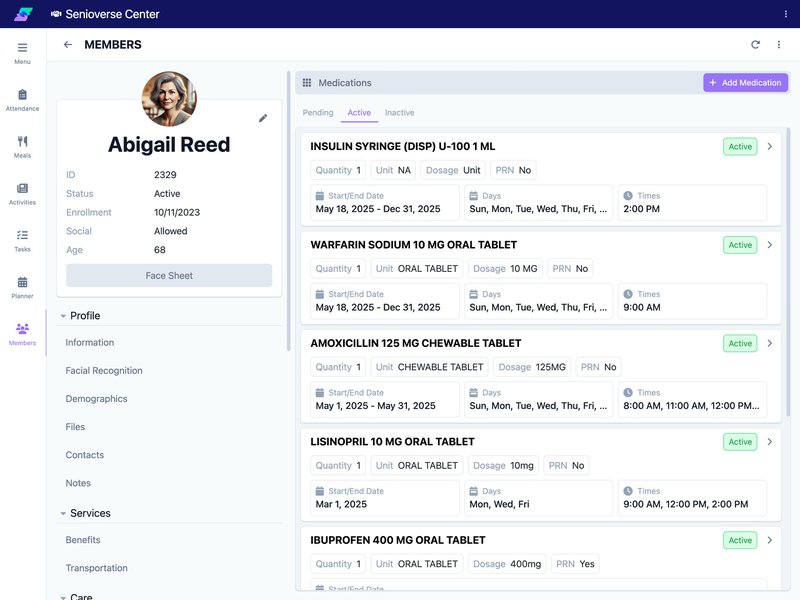
Seniorverse was built specifically for adult day centers so providers don’t have to adapt generic EMRs or home-care tools to fit their workflows. The platform replaces dozens of paper forms with a single, integrated system covering:
Attendance & Transportation (with tablet check-in and facial recognition)
Activities Calendar & Documentation
Digital Assessments & Service Plans
Care Task Management
eMAR & Medication Tracking
Meal & CACFP Documentation
Digital Member Profiles
Audit-Ready Reporting & Exports
Most centers using Seniorverse eliminate 70–90% of their paperwork within the first 60 days, gaining cleaner data, smoother workflows, and more time for participant care.
Best Practices for Transitioning to a Paperless Workflow
Shifting from paper to digital doesn’t have to be overwhelming. Whether you choose Seniorverse or another system, a thoughtful rollout ensures strong adoption and early wins.
Start by digitizing the workflows that drive the most value, such as attendance, service notes, and assessments. Converting familiar paper forms into structured digital templates helps staff transition smoothly.
Training should focus on small, confidence-building tasks: checking in a participant, logging an activity, completing a note. Many centers find that running paper and digital side-by-side briefly (just a few days) eases the shift without prolonging confusion.
From there, measure impact early. Look at billing cycle times, documentation accuracy, missed tasks, and hours saved. These indicators help you fine-tune the rollout and demonstrate ROI.
Beyond boosting efficiency, going paperless also helps address systemic gaps we explored in Bridging Adult Daycare Gaps, strengthening access, reliability, and trust across the industry.
Conclusion: Paperless Solutions Are Not Just Helpful, They’re Necessary
Adult day centers provide critical care and support, yet administrative burdens often stand in the way of meaningful engagement. A paperless solution replaces outdated processes with streamlined, compliant, and connected workflows that support both staff and participants.
For centers looking to eliminate binders, improve accuracy, and modernize operations, going digital isn’t simply a convenience, it’s foundational to the future of adult day services.
Ready to see what a paperless workflow could look like in your center?
Book a free demo of Seniorverse and discover a simpler, smarter way to manage your operations.
Ready to make daily operations easier?
Seniorverse helps adult day centers stay organized, reduce manual work, and keep every record audit-ready.
Ready to make daily operations easier?
Seniorverse helps adult day centers stay organized, reduce manual work, and keep every record audit-ready.

Related articles

Industry trends & policy
0
min read
Alzheimer's & Brain Awareness Month: The 2026 Facts Operators Should Know
Knowing the latest dementia numbers does more than build awareness. It equips your team to have clearer, more grounded conversations with the families you serve. Here are the 2026 facts that matter.
June is Alzheimer's & Brain Awareness Month, a global call to learn the warning signs, support those affected, and wear purple in solidarity. Few causes sit closer to the heart of adult day services, where so much of the care we provide is for people living with Alzheimer's and other forms of dementia.
Knowing the numbers does more than build awareness. It equips you and your staff to have clearer, more grounded conversations with the families who walk through your doors, many of whom are frightened, overwhelmed, and unsure of what comes next. Here is what the latest data tells us, why it matters for your center, and how you can mark the month.
The Scale of Dementia in 2026
According to the Alzheimer's Association's 2026 Alzheimer's Disease Facts and Figures report, more than 7 million Americans are living with Alzheimer's today, a number projected to rise to nearly 13 million by 2050. One in three older adults dies with Alzheimer's or another dementia, and the health and long-term care costs for people living with dementia are projected to reach $409 billion this year alone. Here in New York, an estimated 12.7% of adults over 65 are living with the disease.
Behind every number is a family navigating one of the hardest journeys of their lives, and an adult day center offering them structure, safety, and relief. The work your nurses, aides, and program staff do every day is dementia care at its most human: routine that lowers anxiety, activities that restore purpose, and a watchful eye that catches changes early.
Why These Numbers Matter at Your Center
Statistics like these are not abstract when a family is sitting across from you. They help frame what families are facing, normalize what they are feeling, and point toward the support that exists. A few ways the data translates into better conversations:
- It validates the family's experience. Knowing how common dementia is can ease the isolation families feel. They are not alone, and neither are you in serving them.
- It underscores the value of early support. With prevalence rising and costs climbing, the case for structured, affordable community-based care has never been stronger. Adult day is often the option families do not know exists.
- It frames the role of staff. Your team's daily observation is part of how changes get caught early, and that is worth communicating to families directly.
How Your Center Can Take Part This Month
Awareness Month is a natural moment to engage participants, families, and staff. A few ideas:
- Wear purple and decorate your center; share photos on social media with #ENDALZ
- Host a memory-friendly activity or reminiscence session for participants
- Share CaringKind's Helpline, (646) 744-2900, with families who may need support
- Point families to the Alzheimer's Association's free resources at alz.org
You can also rally your community around the Alzheimer's Association's signature fundraiser. Held around the summer solstice (June 20–21) and now called Do What You Love to End ALZ (formerly The Longest Day), it invites people to turn an activity they love into a way to raise awareness and funds. A small "do what you love" moment at your center is an easy, meaningful way to take part.
A Milestone Worth Celebrating
This year's Awareness Month carries special meaning for our team. Seniorverse is once again an Impact Sponsor of CaringKind's Forget-Me-Not Gala, which marks its 30th anniversary in New York City on June 8th. For more than 40 years, CaringKind has been New York's leading expert on Alzheimer's and dementia caregiving, and because they serve the same families our software is built to support, standing with them is a natural fit. You can read more about why we sponsor the gala each year in our full post.
We are also glad to see brain-health expertise recognized close to home. Our colleague Joanna Mansfield, RN, CCM, was named to the 100 Women of Impact for her leadership in brain health and aging services, work that informs how we think about serving people living with dementia across adult day and community-based care.
Where Families Can Turn for Support
Part of equipping families is knowing where to send them. CaringKind, New York's leading expert on Alzheimer's and dementia caregiving, has spent more than 40 years helping families navigate exactly this. Their Helpline, (646) 744-2900, is staffed by Dementia Specialists, and their programs range from support groups to a wanderer's safety program. The Alzheimer's Association also offers free resources at alz.org.
This Alzheimer's & Brain Awareness Month, the most powerful thing your center can do is what it already does every day: meet families where they are, with knowledge, patience, and care.
Seniorverse builds software that helps adult day and home- and community-based care providers deliver better, more coordinated care for people living with dementia. For families navigating a new diagnosis, see our family caregiver's guide.

Industry trends & policy
0
min read
Why Seniorverse Is a Proud Impact Sponsor of CaringKind's 30th Forget-Me-Not Gala
This Alzheimer's & Brain Awareness Month, we are returning as an Impact Sponsor of CaringKind's Forget-Me-Not Gala. Here is why their three decades of dementia caregiving matters to us.
June is Alzheimer's & Brain Awareness Month, a time to recognize the millions of families living with dementia and the people and organizations who walk alongside them. For Seniorverse, it is also a moment we look forward to each year: we are once again an Impact Sponsor of CaringKind's Forget-Me-Not Gala, which marks its 30th anniversary in New York City on June 8th.
It is a milestone worth pausing on. Thirty years of showing up for families on what is often the hardest journey of their lives.
Three Decades at the Heart of Dementia Caregiving
CaringKind is New York's leading expert on Alzheimer's and dementia caregiving. With more than 40 years of experience, they work directly with community partners to build the information, tools, and training that families affected by dementia need most.
Their support is tangible and human. It includes a Helpline at (646) 744-2900 staffed by Dementia Specialists, individual and family consultations, a wide network of support groups, education programs, early-stage services, and a wanderer's safety program. The guiding principle behind all of it is a simple belief: everyone dealing with dementia deserves the right support, exactly when they need it.
This year, under the theme Connect2Living, the gala celebrates the relationships that sustain people living with dementia and the families and caregivers around them. The evening will also recognize new work focused on the everyday realities of the disease, including a new initiative addressing mealtime and nutrition needs. That attention to dignity in the small, daily moments reflects an often-overlooked part of care: the everyday routines that shape comfort, connection, and quality of life.
Why a Software Company Supports This Cause
People sometimes ask why a technology company invests in an evening like this. The answer is straightforward. We build software for home- and community-based care providers, and a large share of the people served in those programs are living with Alzheimer's and other forms of dementia. The work we do, from streamlining documentation to improving care coordination, is meant to give caregivers back time for the people in front of them. CaringKind serves those same families directly, every day. Supporting their work is a natural extension of ours.
We are glad to see brain-health expertise recognized close to home as well. Our colleague Joanna Mansfield, RN, CCM, was recently named to the 100 Women of Impact for her leadership in brain health and aging services, work that informs how we think about serving people with dementia.
How You Can Support CaringKind
Whether or not you will be in the room on June 8th, there are meaningful ways to stand with this work this month:
- Learn about their programs and services at wearecaringkind.org.
- Share the Helpline with any family who may need it: (646) 744-2900.
- Make a gift. CaringKind is a 501(c)(3) organization (Tax ID 13-3277408), and donations are tax-deductible to the full extent of the law.
Here is to CaringKind's first 30 years, and to every family they will support in the years ahead. We are honored to be in their corner.
Seniorverse builds software for adult day and home- and community-based care providers. Learn more about supporting people living with dementia in adult day programs.

Family & community partnerships
0
min read
Caring for a Loved One With Dementia: A Family Caregiver's Guide
A dementia diagnosis is overwhelming, but you do not have to navigate it alone. Here are the practical first steps, daily care strategies, and support resources that help families cope with more confidence.
A dementia diagnosis changes things, but it does not mean you have run out of good days, and it does not mean you have to figure everything out alone. Whether you are caring for a parent, spouse, or another loved one, the months after a diagnosis can feel overwhelming. This guide walks through what to expect and the practical steps that help families care with more confidence and less fear.
June is Alzheimer's & Brain Awareness Month, a fitting time to share what we have learned from working alongside home- and community-based care providers who support people living with dementia every day.
Understanding the Diagnosis
"Dementia" is not a single disease. It is an umbrella term for a decline in memory, thinking, and reasoning serious enough to affect daily life. Alzheimer's disease is the most common cause, but there are others, including vascular dementia, Lewy body dementia, and frontotemporal dementia. Each progresses differently, so one of the most useful early conversations is with the diagnosing clinician about what type your loved one has and what tends to come next.
You do not need to become a medical expert overnight. You do need a basic map of the road ahead so you can plan rather than react.
First Steps After a Dementia Diagnosis
The early period is about building a foundation. A few priorities tend to matter most:
- Assemble the medical picture. Confirm the diagnosis, review medications, and identify who will coordinate care going forward. Adult day programs and care providers often play a quiet but important role here. See the role of adult day In coordinating medical care.
- Handle legal and financial planning early. While your loved one can still participate in decisions, address powers of attorney, healthcare proxies, and financial access. These conversations are easier now than later.
- Tell the people who need to know. A small circle of family, close friends, and trusted neighbors can become an informal support team.
- Reach out to a dementia expert. You do not have to invent a care plan from scratch. Organizations like CaringKind offer a Helpline staffed by Dementia Specialists at (646) 744-2900, along with consultations and support groups that can save you months of trial and error.
Daily Care Strategies That Actually Help
Day-to-day life with dementia goes more smoothly when the environment does some of the work for you.
Build a predictable routine. Consistency reduces anxiety and confusion. Regular times for meals, activities, and rest give the day a reassuring shape.
Adjust how you communicate. Speak calmly and simply, ask one question at a time, and allow extra time for a response. When memory fails, meet your loved one in their reality rather than correcting them. Connection matters more than accuracy.
Expect changes in behavior, and respond to the need behind them. Agitation, repetition, or resistance are usually signals of an unmet need, such as discomfort, fatigue, hunger, or overstimulation, rather than deliberate behavior. Our deeper look at managing behavioral challenges in dementia care covers practical, compassionate approaches.
Protect nutrition and mealtimes. Appetite, taste, and the ability to use utensils can all change. Simple, familiar foods and an unrushed environment go a long way.
Watch for mood, not just memory. Depression and withdrawal are common and often missed. Learn the signs of depression and Isolation in seniors so you can raise concerns with a clinician early.
How Adult Day Programs Support People With Dementia
One of the most underused resources for dementia families is adult day care. A well-run program offers structured, engaging activities in a safe setting, giving your loved one social connection and purpose while giving you predictable, reliable respite.
The best programs go far beyond basic supervision. They build specialized Alzheimer's and dementia programming designed to match each participant's stage and strengths. For many families, adult day is also a meaningfully more affordable option than full-time care. See adult day care vs. long-term care: a cost-smart alternative.
If you are weighing whether a program is right for your family, it can help to start with how to talk to a parent about adult day care.
Do Not Forget to Care for the Caregiver
Caregiver burnout is not a sign of failure. It is a predictable result of carrying too much for too long without support. You will be a better caregiver, and a healthier person, if you treat your own well-being as part of the care plan rather than an afterthought.
Build in respite, accept help when it is offered, and protect a few non-negotiable things that restore you. Our guide to stress-relief tools to avoid caregiver burnout offers practical starting points, and if you are juggling care with a job, balancing work and caregiving responsibilities can help.
You Do Not Have to Do This Alone
The single most important thing to remember after a diagnosis is that support exists, clinical, practical, and emotional. Lean on it early and often.
If you are in the New York area or simply need expert guidance, CaringKind has spent more than 40 years helping families navigate exactly this. Their Helpline, (646) 744-2900, connects you with Dementia Specialists, and their programs and services range from support groups to a wanderer's safety program.
Dementia asks a great deal of the families who face it. With the right plan, the right team, and the right support, you can meet it with more steadiness, and still find good days along the way.
Seniorverse builds software that helps adult day and home- and community-based care providers deliver better, more coordinated care for people living with dementia.