
Blog
Operations & documentation
Modern approaches to accuracy, accountability, and efficiency.

Operations & documentation
0
min read
How to Build a Compliance Calendar for Your Adult Day Center
Compliance in adult day programs is not a single deadline; it is a year-round discipline. This practical framework helps you organize recurring obligations into a proactive calendar that keeps your center protected and audit-ready.
Most compliance failures in adult day centers are not caused by willful neglect. They happen because of a missed renewal, an expired background check no one tracked, or a care plan update that got pushed to next week and then forgotten. These obligations pile up quietly across multiple regulatory frameworks. Without a reliable system to manage them, they tend to surface at the worst possible moment: during an audit, a licensing inspection, or a billing review.
One practical solution is creating a compliance calendar. This tool translates every recurring obligation your program carries into a scheduled task with a named owner and enough lead time to complete it before it becomes urgent. It does not need to be highly complex. What matters is that your calendar is comprehensive, clearly assigned, and consistently consulted by your team.
Map Every Recurring Obligation
Before building the calendar, you need a full inventory of your center's responsibilities. The compliance landscape in adult day care operates across distinct regulatory frameworks, and each has its own cadence.
- Medicaid billing and documentation: This includes claim submission deadlines, prior authorization renewal windows, and care plan reviews tied to Medicaid managed care timelines. Any state-specific documentation retention requirements also fall into this category. Your state Medicaid provider manual is the authoritative source for these deadlines. Review it annually to establish your baseline.
- CACFP recordkeeping: If your program participates in the Child and Adult Care Food Program (CACFP), you must retain all program records for three years after the end of the relevant fiscal year (or longer if audit findings remain open). The CACFP fiscal year runs from October 1 through September 30. This means your retention window and your annual administrative review cycle are both anchored to that specific date.
- Staff credentialing and background checks: Federal law requires all staff in regulated programs to pass criminal background checks. Most states require a renewal on a five-year cycle from the date of the initial fingerprinting. With turnover common in direct care settings, this is one of the most frequently lapsed items because the renewal date ties to each individual's hire date rather than a program-wide deadline.
- Person-Centered Service Plans (PCSPs): Federal Home and Community-Based Services (HCBS) regulations dictate that participant assessments and person-centered plans must be reviewed and updated at least annually for participants continuously enrolled for 365 days or longer. Many states mandate more frequent reviews, particularly for participants experiencing significant cognitive or functional changes. Check your specific state HCBS regulations for exact timelines.
- State licensing and program certification: License renewal cycles, required annual training hours, facility inspection schedules, and any program-specific certifications each carry their own strict deadlines.
Once you list every obligation, note three crucial details for each item: the deadline or renewal window, how far in advance preparation realistically needs to begin, and who on your team is responsible for completing the task.
Structure the Calendar by Quarter
A year-round compliance calendar works best when you distribute obligations into quarterly views. This ensures no single month carries an overwhelming administrative load, and gaps in coverage become visible at a glance.
- Q1 (January through March): This quarter serves as a natural reset point. Use this time to audit your staff credentialing files. Pull a list of every employee's background check date and calculate when their five-year renewal falls. Initiate any renewals due in Q2 or Q3 now, since state processing timelines vary and can often take weeks. This is also a great time to verify that all participant PCSP review dates are current and to schedule any annual reassessments due before June.
- Q2 (April through June): State licensing inspections frequently occur during these months, though your state's specific cycle will dictate the actual schedule. Review your facility files (including emergency plans, staff training logs, medication administration records, and incident documentation) against your licensing checklist before mid-quarter.
- Q3 (July through September): This period covers the approach to the CACFP fiscal year end on September 30. Conduct a record-keeping review to confirm that all meal count records, income eligibility forms, and claim documentation for the expiring program year are complete and properly organized for the three-year retention window. Many programs also conduct annual staff performance reviews in Q3, making it an ideal time to confirm that staff have met their required in-service training hours for the program year.
- Q4 (October through December): Q4 opens the new CACFP program year and is a natural time to review contracts, insurance policies, or vendor agreements that renew on a calendar-year basis. Review your billing performance data for the year and address any outstanding claim denials or authorization lapses before year-end. If your state licensing cycle runs on a calendar year, you typically need to submit renewal documentation during this window.
Assign Ownership, Not Just Deadlines
A compliance calendar with tasks but no named owners is simply a wish list. Every item needs a person responsible for completing it and a person responsible for confirming it was done. In smaller centers, this is often the same person, typically the director or administrator. In larger programs, distributing ownership across clinical, administrative, and program staff creates accountability and reduces single points of failure.
For higher-stakes items like background check renewals, PCSP updates, and CACFP review windows, build in a reminder two to four weeks before the deadline. Do not just mark the final due date. This proactive lead time is exactly what turns a compliance task from a reactive scramble into a manageable process. For example, if a nursing director is responsible for PCSP updates, the calendar should prompt them a month in advance to schedule the necessary family meetings.
Use a System That Surfaces Deadlines Automatically
A printed calendar or spreadsheet works well for programs just starting to formalize this process. However, as your program grows and your census increases, manual tracking becomes a vulnerability. Implementing participant management and documentation software like Seniorverse can significantly reduce this administrative burden by automating task tracking, surfacing reminders, and helping staff stay ahead of key deadlines. Seniorverse unifies all data and workflows into a single platform, reducing manual work and paperwork while keeping every record organized and audit-ready. This allows staff to move faster, stay accurate, and spend more time on care.
The underlying principle remains the same regardless of the tool. Every compliance obligation your program carries should have a visible due date, a responsible owner, and enough lead time to complete the work comfortably. When your system runs smoothly, audits and inspections simply become a confirmation of what you already know is in order.

Operations & documentation
0
min read
KPIs Every Adult Day Operator Should Track
If you cannot measure it, you cannot manage it. These are the specific metrics that reveal the true health of your adult day program and the early warning signs you cannot afford to miss.
Most adult day operators possess a strong intuition about how their program is performing on any given day. You likely know when attendance feels light, when the billing cycle is lagging, or when staff burnout is creeping in. However, relying on intuition is not a sustainable management strategy. Without tracking specific numbers consistently over time, you end up reacting to problems only after they have grown into crises. By that point, the operational and financial damage is already done.
A well-chosen set of Key Performance Indicators (KPIs) does not require a dedicated data analyst. It simply requires deciding what to measure, building a routine to pull those numbers, and actually using that data to make informed decisions. The metrics outlined below cover the areas that matter most for adult day operations: census, attendance, enrollment duration, staffing, incidents, billing, and referrals. Tracking these consistently will transform how you manage your center.
Census and Attendance
Two numbers form the absolute financial foundation of your program: your total enrolled census and your average daily attendance (ADA). Your census tells you how many participants are currently on your roster. Your ADA tells you how many of those individuals are actually walking through the door each day.
The gap between these two figures is your first and best diagnostic tool. If your center has an enrolled census of sixty participants but an ADA of only twelve, you do not have a marketing problem. You have an engagement, transportation, or scheduling problem. Tracking ADA weekly and comparing it to your licensed facility capacity provides a clear picture of your revenue-generating potential versus what you are actually billing.
A related metric worth calculating at the end of every month is your attendance rate per participant. To find this, divide the number of days a participant actually attended by the number of days they were scheduled to attend. Participants who consistently show up less often than scheduled are at a high risk of unenrolling. This drop in attendance often serves as an early warning sign that something has changed at home. It could indicate a decline in health, a new transportation barrier, or simply a growing dissatisfaction with the program. Catching this pattern early gives your team a valuable opportunity to intervene and adjust the care plan.
Average Length of Enrollment
How long do participants typically stay enrolled in your center? This is a metric many operators have never formally calculated, yet it remains one of the most informative measures of program quality and clinical appropriateness.
A short average length of enrollment, such as under three months across your entire census, usually indicates a systemic issue. It might mean that participants are only arriving when their families are in crisis, that your programming is not meeting their specific needs, or that care transitions out of the program are not being managed proactively. Conversely, a longer average of twelve months or more generally reflects strong participant engagement, highly satisfied families, and effective care coordination.
Calculate this metric quarterly by pulling a list of your recently discharged participants and averaging the time from their initial enrollment date to their discharge date. Track this average over time. If the duration is steadily declining, that trend deserves an immediate investigation before it snowballs into a larger census problem.
Staff-to-Participant Ratio and Turnover
Your daily staff-to-participant ratio is both a strict regulatory requirement and a critical operational quality indicator. Most states specify minimum staffing ratios for adult day programs, though these requirements vary heavily based on program type and participant acuity. Always verify your specific requirements with your state licensing agency.
Beyond meeting the regulatory minimum, your actual ratio on any given day reveals whether your program can realistically deliver the experience it promises. A day when the ratio stretches beyond safe or comfortable limits is a day when participant engagement suffers, incidents become far more likely, and your staff experiences immense stress. Tracking ratio data over time directly informs your staffing model. If you are consistently running lean on your busiest days, you likely need a more flexible on-call roster or a completely different scheduling approach.
A secondary staffing KPI you absolutely must track is your staff turnover rate. Calculate this by dividing the number of staff departures in a twelve-month period by your average total staff count. Turnover in senior care settings is incredibly costly. It drains resources through direct hiring expenses and causes massive disruption to participant relationships and overall program continuity.
Incident Rates and Patterns
Every single incident at your center must be logged. This includes falls, behavioral episodes, medication errors, and participant elopements. The aggregate of that data over time forms your incident rate, which is typically expressed as the number of incidents per one hundred participant days.
This metric serves two vital purposes for operators:
- Care quality indicator: A rising incident rate clearly signals that something within your physical environment, your daily programming, or your staffing model needs immediate attention.
- Liability management tool: Programs that track incidents systematically and can demonstrate clear response patterns are far better positioned during a licensing review or a legal inquiry than programs with scattered, incomplete logs.
Calculate your incident rate monthly and review the data by incident type. Falls are the most common category in adult day settings, and they often have highly preventable causes. Targeted data can reveal patterns related to specific floor surfaces, improper footwear, poor lighting, or rushed activity pacing.
Billing Cycle Time and Claims Performance
Your billing cycle time is the number of days from the actual date of service to the moment a clean claim is submitted to the payer. Shorter cycle times drastically improve cash flow. Long cycle times are almost always a symptom of documentation delays upstream, such as incomplete daily activity logs or missing provider signatures.
Alongside cycle time, you should track two additional billing metrics:
- Clean claim rate: This is the percentage of claims accepted by the payer on the first submission without requiring any corrections. A clean claim rate below 90 percent suggests systemic documentation or coding errors that your administrative team needs to investigate.
- Days in accounts receivable (AR): This measures the average number of days outstanding across all open claims. Medicaid claims should typically be resolved within 30 to 45 days of submission in most states. Any claims aging beyond 90 days signal a major gap in your follow-up workflow.
When your billing data is housed in a modern digital system, such as the Seniorverse billing platform, these metrics are incredibly easy to generate. For programs still managing billing through manual spreadsheets, even a rough monthly calculation of outstanding claims by age is a meaningful starting point.
Referral Source Conversion Rate
Where are your new enrollments actually coming from? This is a KPI that most operators track very loosely at best, yet it directly determines where you should be spending your business development time.
You need to track every new inquiry and enrollment back to its specific source. Common sources include hospital discharge planners, primary care physician referrals, the local Area Agency on Aging (AAA), family word-of-mouth, or your center's website. On a monthly basis, calculate your referral conversion rate by source. This is the percentage of inquiries from each specific channel that successfully resulted in an admission.
This conversion data tells you exactly which referral relationships are producing results and which are generating inquiries that simply do not fit your program. Over a single quarter, a basic referral source log will reveal patterns that should reshape how you allocate your outreach time. The social worker who sends three perfectly matched referrals every month is well worth a quarterly in-person visit. The online channel generating ten inquiries with zero actual conversions deserves a completely different kind of attention.
Building the Habit
Start by choosing just four or five of these metrics. Pull the numbers once a month and place them in a single tracking document. You do not need a complicated dashboard on day one. A straightforward spreadsheet updated consistently is far more valuable than a complex reporting tool that nobody on your team ever opens. The goal is to build the habit of looking at your program through objective data rather than relying solely on intuition.
As your center grows, manually compiling these KPIs will become increasingly time-consuming. This is where purpose-built software becomes invaluable. Platforms like Seniorverse automatically track daily attendance, monitor staff ratios, flag incident patterns, and generate clean billing reports without requiring hours of manual data entry.
Operators who track these numbers regularly find that operational bottlenecks surface much earlier. Decisions regarding staffing or expansion get easier to justify, and conversations with funders and licensing agencies become completely grounded in facts. The data you need to run a stronger center is already there. It just needs the right system to bring it into focus.

Operations & documentation
0
min read
Private Pay Strategies for Adult Day Centers: Diversifying Beyond Medicaid
Medicaid will always be part of the funding mix for adult day programs, but relying on it entirely is a financial risk. Learn how to structure private pay rates, unlock additional revenue streams, and build a more resilient business.
A Medicaid reimbursement rate is a baseline for survival, not a blueprint for growth. When state budgets tighten and rates stagnate, adult day center operators who rely entirely on a single government payor feel the squeeze immediately. Medicaid reimbursement often covers the bare minimum cost of care, but it rarely leaves enough margin to reinvest in specialized staffing, diverse programming, or facility improvements.
Expanding your revenue model is not about abandoning Medicaid participants or the community-focused mission that drives most adult day operators. Instead, diversifying your income streams ensures your program remains financially stable enough to serve those vulnerable populations over the long term. Medicaid will always remain a vital part of the financial mix. The critical question for operators is what else belongs in that mix to build a resilient, thriving business.
Build a Private Pay Program with a Clear Pricing Structure
Implementing a private pay model in an adult day setting does not mean you are exclusively offering premium, luxury care. It simply means establishing a rate that reflects the actual cost of delivering your services while clearly communicating their value to families who are paying out of pocket.
Setting the right rate starts with an analysis of your cost structure. You must calculate your true daily cost per participant by factoring in staff wages, facility overhead, meals, program supplies, liability insurance, and administrative expenses. Once you have that baseline, you can establish a margin that allows your business to sustain itself. Pricing your services significantly below cost simply because a higher rate feels uncomfortable to justify is a dangerous trap that many operators fall into.
When you communicate your private pay rate to families, frame it relative to the alternatives. Full-time in-home care or residential assisted living can cost thousands of dollars more per month than a comprehensive adult day program. This comparison is genuinely compelling to families managing tight care budgets. Make sure to present all daily, weekly, and monthly rate options where possible. Families planning a regular weekly schedule respond much better to a predictable monthly figure that fits their budget rather than a per-day number that feels variable and unpredictable.
Service Tiering: Creating Options Without Complexity
A tiered service model offers families a base level of care at a standard daily rate, with premium add-on services available for an additional fee. When executed well, tiering expands your revenue per participant without overcomplicating your daily operations. Common tiering structures include the following options:
- Base Tier: Core programming, nutritious meals, standard supervision, and basic health monitoring.
- Enhanced Tier: Specialized programming like memory care or advanced physical activity classes, door-to-door transportation, and additional therapy time.
- A La Carte Add-Ons: Individual services families can select as needed, such as bathing assistance, specialized creative workshops, or one-on-one activity support.
The key discipline in tiering is keeping the add-on menu short and the operational delivery incredibly consistent. A menu of ten optional services that your staff struggles to track is far worse than three services executed reliably every single time. Start simple, track what your community actually requests, and expand your offerings based on proven demand.
Long-Term Care Insurance: An Underutilized Revenue Stream
Many adult day operators treat long-term care insurance (LTCI) as an occasional, lucky situation rather than a structured billing workflow. That mindset represents a massive missed opportunity. LTCI policies are specifically designed to cover community-based services like adult day care. Qualifying participants typically need to demonstrate a need for assistance with at least two activities of daily living (ADLs) or a diagnosed cognitive impairment. A large percentage of adult day participants easily meet these criteria.
The primary operational requirement for successful LTCI billing is pristine documentation. LTCI claims require solid evidence of medical necessity, a formal assessment of ADL or cognitive impairment, and consistent daily service records. Centers that already maintain thorough participant documentation are well-positioned to support these claims without taking on a significant administrative burden.
The practical steps to build LTCI billing into your standard workflow include:
- Asking whether the participant holds a long-term care insurance policy during the initial enrollment interview.
- Obtaining the policy number and insurer contact information, followed by a request for a copy of the benefit summary.
- Confirming exactly which documentation the specific insurer requires for ongoing claim submission.
- Assigning a dedicated point of contact on your administrative team to manage LTCI billing and follow up on claim statuses.
Once you establish this workflow, LTCI billing is not substantially more complex than Medicaid billing, and the reimbursement rates are typically much stronger.
VA Benefits: A Specific Pathway Worth Pursuing
The Veterans Affairs (VA) Adult Day Health Care program covers community-based adult day services for enrolled veterans with a clinical need as part of the standard VA medical benefits package. For centers located near military communities or serving areas with significant veteran populations, pursuing VA Community Care Network (CCN) authorization is absolutely worth the initial credentialing effort.
Additionally, veterans receiving VA pension benefits can apply those funds toward adult day costs. The VA Aid and Attendance benefit is specifically designed to help veterans and surviving spouses afford necessary care. Adult day center costs can typically be deducted from a veteran's gross income when calculating benefit eligibility. Many families navigating VA benefits are often completely unaware of this option. Centers that train their intake team on this pathway gain a meaningful advantage. When your staff can walk families through these basic steps, you are much more likely to convert veteran prospects who initially cite out-of-pocket cost as a barrier.
Wellness Add-Ons as Revenue Diversification
Beyond standard service tiering, some adult day programs incorporate discretionary wellness offerings. Participants or their families pay for these services separately, and they carry a highly favorable profit margin. Examples that have worked well in practice include:
- Chair-based fitness or fall-prevention classes delivered by a contracted physical therapist.
- Art therapy or music therapy sessions offered in small groups as specialized enrichment programming.
- Structured caregiver support groups that meet weekly and are open to families of both current and prospective participants for a small fee.
These are not core services, and you should not price or staff them like core services. They work best as scheduled, vendor-delivered, or group-based offerings where your incremental cost remains low while the perceived value to participants and families remains incredibly high.
How to Take the Next Step
If your center is primarily Medicaid-funded today, the goal is not to flip that ratio overnight. The goal is to open the next logical revenue channel, get the internal workflow right, and then build upon that success. Start by conducting a private pay rate review if yours has not been updated in the last twelve to eighteen months. Identify whether asking about long-term care insurance is a standard part of your intake process. Finally, ask yourself honestly what would happen to your program if Medicaid reimbursement in your state dropped by ten percent next year.
The answer to that question is your immediate business case for diversifying your revenue streams today.
Managing multiple payor sources, private pay tiers, and complex billing requirements can quickly overwhelm a manual spreadsheet system. This is where purpose-built operational software becomes essential. Seniorverse helps adult day centers streamline their documentation, track varied billing rates, and manage care plans across Medicaid, VA, and private pay participants in one unified platform. Having the right digital tools in place ensures that as you expand your revenue streams, your administrative team never misses a beat.

Operations & documentation
0
min read
How to Prepare for a Medicaid Audit at Your Adult Day Center
Medicaid audits of adult day programs are intensifying nationwide. Learn what auditors look for, where documentation commonly breaks down, and how to build daily habits that protect your center's funding.
In February 2026, New York State Comptroller Tom DiNapoli released an audit identifying over $285 million in questionable Medicaid payments to Social Adult Day Care programs. The flagged payments were tied to missing attendance records, services billed for deceased participants, and claims lacking proper supporting documentation. While that staggering figure represents years of accumulated risk in one state, it serves as a clear signal to directors everywhere. Regulators are paying closer attention, and the heightened scrutiny is not limited to New York.
A Medicaid audit does not have to be a crisis. For centers with clean records and consistent operational processes, an audit is a manageable event. However, for programs operating with documentation gaps, billing shortcuts, or informal manual workarounds, an audit can result in severe recoupment demands, sanctions, or even forced closures. The difference between a routine review and a financial issue usually comes down to the daily habits your team builds long before an auditor ever calls.
What Auditors Are Actually Looking For
Medicaid auditors reviewing adult day claims are focused on one core question. They want to know if the billed service was actually delivered to an eligible participant on the date claimed and in the exact manner authorized. This requirement sounds straightforward in theory. In practice, proving this requires a continuous chain of documentation that many centers struggle to maintain consistently.
When auditors dig into your records, they are actively looking for specific red flags. The most common issues found in adult day programs include the following:
- Missing or incomplete attendance records: Daily attendance sheets are the foundation of every billing claim. If your state or managed care plan requires a participant's signature, a staff countersignature, or specific digital time stamps, missing these details leaves the claim entirely vulnerable. This remains true regardless of whether the person was actually present in your building.
- Claims billed for ineligible dates: Billing for holidays, center closures, or dates when a participant was hospitalized is among the clearest indicators of a systemic documentation breakdown. Data analytics tools used by state agencies can easily catch these overlapping dates.
- Services billed without an active authorization: Every billable service must link back to a current and approved care plan. Claims submitted after an authorization has expired, or before a new one is officially in place, are a recurring and costly audit finding.
- Incomplete intake and assessment records: Auditors rigorously review whether participants met the required clinical eligibility criteria at enrollment. They also check whether functional assessments were updated on the strict state-mandated schedule.
- Insufficient transportation logs: If your center bills Medicaid for transportation, pick-up and drop-off logs must adhere to your state's documentation rules, which often include exact times and, in some cases, staff or participant signatures. These logs need to match your claim dates perfectly to prove the service occurred.
Where Documentation Usually Breaks Down
Most documentation problems in adult day centers are not the result of intentional fraud. Instead, they are the direct result of operational pressure. High participant-to-staff ratios, paper-based workflows, and chaotic end-of-day routines frequently leave sign-in sheets incomplete or care plan updates postponed.
Consider a typical afternoon at a busy center. If an activity coordinator is forced to fill out paper attendance logs from memory at 5:00 PM while families are arriving for pickup, errors are inevitable. Over time, these small gaps accumulate into patterns that look highly problematic to an auditor, even when no harm was intended and the actual care provided was excellent.
Disconnected billing cycles further compound the issue. When billing runs weekly or biweekly, administrative staff often submit claims before all supporting documentation has been thoroughly completed and reviewed by clinical staff. The claim goes out to the payer, but the missing staff sign-off or authorization check never gets resolved.
Submitting unsupported claims creates a massive financial liability. A robust billing software system links claim submission directly to completed documentation. For example, requiring that a day's attendance records are digitally locked before any claims can be generated for that date closes this gap structurally. You no longer have to rely on individual follow-through to ensure compliance.
Building an Audit-Ready Operation
Audit readiness is not a frantic project you undertake when an official notice arrives in the mail. It is a set of daily and monthly habits that make your records defensible at any given time. By implementing a few structural changes, you can protect your center from recoupment risk.
Conduct Monthly Internal Spot Checks
Do not wait for an annual review to find out your staff are missing critical documentation. Assign a dedicated staff member, or take an hour yourself, to pull a random sample of fifteen claims from the prior month. Trace each of those claims back to its supporting records. Verify the attendance log, the active authorization, the care plan, and any required daily service notes. This surface-level spot check will reveal systemic gaps early enough for you to retrain staff and correct the workflow.
Establish a Bulletproof Authorization Tracking Process
You must know at any given moment which participants have active authorizations, which are coming up for renewal, and which have lapsed. An expired authorization is one of the most avoidable billing errors in this industry. It is also one of the most common audit findings. A reliable tracking system removes the guesswork entirely. Modern digital tools, such as the Seniorverse platform, keep both clinical and administrative staff well informed on the status of care plans, helping to mitigate issues around providing unbillable care.
Standardize Your Attendance Documentation
Every program's day should end with a completely finalized attendance record. Depending on your local regulations, this might include participant signatures, staff verification, and a specific note for any absence or early departure. The format matters less than the consistency, though digital systems are inherently more reliable than paper. If your current manual process produces five complete records and two incomplete ones every week, that inconsistency represents a major financial risk.
Centralize Participant Records
Auditors expect quick access to comprehensive files. If a state surveyor asks for a participant's history, pulling a medical binder from the nursing station, an attendance sheet from the front desk, and a billing ledger from the back office is a recipe for disaster. Consolidating intake, care planning, daily activity tracking, and billing into a single software platform ensures that your records are always organized. Having a single source of truth dramatically reduces staff stress during an audit and prevents accidental alterations of historical records.
Know Your State's Specific Requirements
Medicaid billing rules for adult day services vary drastically across the country. Because Medicaid adult day documentation rules differ by state, waiver type, and managed care arrangement, providers should confirm exactly what attendance, transportation, and care plan documentation their state Medicaid agency and contracted plans require.
Service types, billing unit definitions, and audit triggers also differ across programs. If you are not completely certain what your specific authorities demand as supporting documentation for each claim type, that is the first research task on your list. Your state's Medicaid provider manual is the authoritative source, and your leadership team should review it annually.
What to Do When an Audit Notice Arrives
If your program receives an audit notice, your response process matters just as much as your underlying records. First, designate a single point of contact within your facility for all auditor communication. Having multiple staff members answering questions can lead to conflicting information and expanded scrutiny.
Gather the requested records promptly and organize them to match the auditor's request exactly. Disorganized or incomplete responses create the immediate impression of larger operational problems. If the audit involves a significant volume of claims or highly complex billing issues, engaging a healthcare compliance consultant or an attorney with specific Medicaid experience is a very reasonable step to protect your business.
Most importantly, do not wait for the notice to start preparing. The centers that handle audits smoothly are the ones that ran clean, compliant programs long before the call came. Build a culture of strict documentation today. When you implement the right software and establish strong daily habits, an audit becomes a simple validation of your excellent work rather than a threat to your center's future.

Operations & documentation
0
min read
Paperless Solutions for Adult Day: Benefits, Tools, and Best Practices
Paperwork slows down adult day operations, increases compliance risk, and pulls staff away from participant care. A paperless solution helps centers streamline documentation, strengthen audits, improve billing accuracy, and create more time for what matters most—supporting older adults.
Adult day centers are busier than ever. With rising enrollment, stricter Medicaid regulations, staffing shortages, and increasing documentation demands, paper-based workflows are becoming too slow and too risky to sustain. Attendance sheets, service notes, medication logs, assessments, and incident reports stack up quickly, ultimately slowing staff down and making errors more likely.
As we outlined in Senior Living 2030: Preparing for Unprecedented Demand, adult day providers must adopt scalable technology to meet the needs of a rapidly aging population. One of the most effective ways to do that is by going paperless. Digital solutions allow teams to document care in real time, securely store records, communicate more efficiently, and eliminate the chaos of binders and filing cabinets.
The Hidden Costs of Paper in Adult Day Services
Many centers stick with paper simply because it’s familiar. But the operational burden is significant.
Paper slows everything down. Staff rewrite notes, search for misplaced files, repeat data entry, and manually align attendance with service notes. This administrative load not only heightens burnout but also pulls energy away from engaging participants.
It also adds compliance risk. Missing forms, illegible handwriting, and inconsistent documentation can create major vulnerabilities during Medicaid audits. And when participant information, like contacts, allergies, risk flags, and service plans, is scattered across binders or office desktops, continuity of care suffers.
Finally, paper disrupts cash flow. When documentation lags, billing lags. Providers often wait days or even weeks to reconcile paper records, causing avoidable reimbursement delays.
In short: paper workflows hide a high operational cost that centers feel every single day.
What a True Paperless Solution Looks Like
Not every digital tool fully replaces paper. A true paperless solution supports the entire lifecycle of participant care, from check-in to documentation to reporting. The most impactful components typically include:
Digital Attendance Tracking: Real-time check-in/out, transportation logs, or facial recognition that sync directly with reporting and billing.
Electronic Notes & Activity Documentation: Group activities, one-on-one services, and daily care tasks captured from a tablet instead of written by hand.
Digital Assessments & Service Plans: Structured templates that keep evaluations consistent, accessible, and compliant.
eMAR & Medication Management: Digital dosage tracking that reduces transcription errors and keeps everything time-stamped.
Centralized Participant Profiles: One secure place for demographics, contacts, medical details, assessments, care plans, attendance history, and more.
Audit-Ready Reporting: Instantly exportable formats for Medicaid, CACFP, case managers, and compliance teams.
Staff Communication & Task Management: Alerts, to-dos, and schedules that prevent missed tasks and strengthen team coordination.
Together, these tools remove friction, reduce errors, and create a clearer picture of what’s happening across the center.
How Going Paperless Transforms Adult Day Operations
When centers replace manual forms with digital tools, the impact is immediate. As highlighted in How Adult Daycare Eases the Senior Care Staffing Crisis, reducing administrative workload is one of the most effective ways to support staff retention and improve care quality.
A paperless workflow creates efficiencies across four major areas:
1. Staff Time and Experience
Centers consistently save hours each week when attendance logs, care notes, and internal communication move online. This reclaimed time goes back to engaging participants, rather than chasing paperwork.
2. Data Accuracy and Compliance
Digital documentation eliminates illegible handwriting, missing signatures, and mismatched forms. With time-stamped entries stored securely, Medicaid audit prep becomes far more predictable.
3. Real-Time Visibility for Administrators
Live dashboards reveal trends and gaps instantly, such as attendance patterns, missed meals, outstanding assessments, medication tasks, and more. Paper simply can’t provide that level of operational clarity.
4. Reduced Administrative Costs
Less printing, fewer storage needs, and faster billing cycles reduce overhead while strengthening financial sustainability.
How Seniorverse Helps Centers Go Fully Paperless
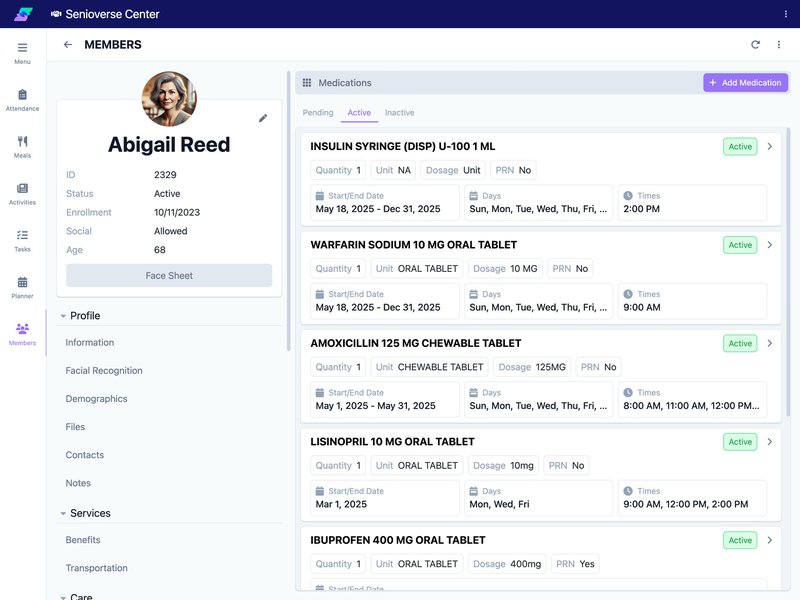
Seniorverse was built specifically for adult day centers so providers don’t have to adapt generic EMRs or home-care tools to fit their workflows. The platform replaces dozens of paper forms with a single, integrated system covering:
Attendance & Transportation (with tablet check-in and facial recognition)
Activities Calendar & Documentation
Digital Assessments & Service Plans
Care Task Management
eMAR & Medication Tracking
Meal & CACFP Documentation
Digital Member Profiles
Audit-Ready Reporting & Exports
Most centers using Seniorverse eliminate 70–90% of their paperwork within the first 60 days, gaining cleaner data, smoother workflows, and more time for participant care.
Best Practices for Transitioning to a Paperless Workflow
Shifting from paper to digital doesn’t have to be overwhelming. Whether you choose Seniorverse or another system, a thoughtful rollout ensures strong adoption and early wins.
Start by digitizing the workflows that drive the most value, such as attendance, service notes, and assessments. Converting familiar paper forms into structured digital templates helps staff transition smoothly.
Training should focus on small, confidence-building tasks: checking in a participant, logging an activity, completing a note. Many centers find that running paper and digital side-by-side briefly (just a few days) eases the shift without prolonging confusion.
From there, measure impact early. Look at billing cycle times, documentation accuracy, missed tasks, and hours saved. These indicators help you fine-tune the rollout and demonstrate ROI.
Beyond boosting efficiency, going paperless also helps address systemic gaps we explored in Bridging Adult Daycare Gaps, strengthening access, reliability, and trust across the industry.
Conclusion: Paperless Solutions Are Not Just Helpful, They’re Necessary
Adult day centers provide critical care and support, yet administrative burdens often stand in the way of meaningful engagement. A paperless solution replaces outdated processes with streamlined, compliant, and connected workflows that support both staff and participants.
For centers looking to eliminate binders, improve accuracy, and modernize operations, going digital isn’t simply a convenience, it’s foundational to the future of adult day services.
Ready to see what a paperless workflow could look like in your center?
Book a free demo of Seniorverse and discover a simpler, smarter way to manage your operations.

Operations & documentation
0
min read
Digital Transformation in Senior Care is Long Overdue
Digital transformation is critical for senior care, especially adult daycare, where outdated manual processes burden staff and hinder care quality. By adopting tools like EHRs, scheduling apps, and family portals, providers can streamline operations, reduce errors, and enhance participant engagement. Despite financial hesitations, digital investments cut hidden costs and improve outcomes. Now is the time to modernize senior care for better efficiency, compliance, and compassionate support.
Across the United States, senior care facilities are caught in a cycle of administrative overload, paperwork, and reactive care. While many industries have embraced digital transformation to reduce operational inefficiencies and improve outcomes, senior care (particularly community-based services like adult daycare) has largely been left behind.
The lag is rooted in financial constraints, long-standing practices, and a general underinvestment in systems that could dramatically improve the quality of care. As staffing shortages persist, margins shrink, and the needs of our aging population become more complex, the case for going digital has never been stronger, or more urgent.
A System Under Pressure
Walk into a typical adult daycare center and you’ll often see handwritten intake logs, whiteboards filled with reminders, and staff toggling between spreadsheets, phones, and paper files just to manage the day’s operations. While these methods may have served providers in the past, they are no longer sustainable in a fast-evolving world.
According to a 2022 Health Affairs study, only about a quarter of long-term care providers have implemented advanced health information technology systems. That means the majority are still relying on outdated workflows that increase errors, duplicate work, and limit their ability to make data-informed decisions.
The result? A heavier administrative burden placed on already-stretched staff and missed opportunities to enhance the lives of seniors.
The Price of Standing Still
One of the biggest barriers to digital transformation in senior care is the belief that it’s too expensive. With many adult daycare centers operating on thin margins and limited public funding (often through Medicaid or community grants). there’s a natural hesitation to invest in new platforms or hire IT professionals.
These financial considerations, while understandable, can be shortsighted. Failing to adopt digital systems creates ongoing hidden costs: inefficient billing, missed reimbursements, increased staffing needs, and lower staff retention due to burnout. Time spent manually entering data or correcting paperwork could instead be directed toward participant engagement and care planning. Investments in technology are not just an operational upgrade, but a means to stabilize the senior care workforce and improve long-term sustainability.
Antiquated Processes, Lower Quality Care
Poor documentation processes don’t just slow things down, they impact health. Manual medication tracking, for example, is prone to human error. Delays in communication between caregivers and families can lead to confusion and missed appointments. The absence of centralized data makes it harder to detect patterns, address emerging health issues, or refine programming based on patient needs.
When operations are disorganized, seniors feel it. They may miss meals, receive inconsistent care, or disengage socially due to miscommunication or scheduling issues. Over time, this leads to lower levels of social engagement, poorer health outcomes, and increased caregiver burden.
Investing in digital tools that streamline operations, such as attendance tracking, medication reminders, or family communication portals, can help reclaim time and reallocate it where it matters: with the participants.
Digital Transformation In Practice
Digital transformation in senior care doesn’t mean a complete overhaul overnight. It starts with incremental improvements: replacing paper forms with digital check-in systems, adopting software for care planning, integrating automated billing systems, or implementing digital communication tools for families and staff.
Some of the most promising innovations include:
- EHR platforms to manage medical records
- Activity scheduling tools that improve participation
- AI-powered analytics that help detect early signs of health deterioration
- Secure portals that allow families to check in on their loved one’s day, meals, and appointments
- These tools not only improve the quality of care, but also strengthen relationships with caregivers, families, and regulatory agencies.
Tailored Solutions for Adult Daycare
Within adult daycare, specifically, digital tools can address common operational pain points like daily attendance logs, activity tracking, medication administration, and transportation scheduling. For providers dealing with frequent changes in participant schedules, medication routines, or Medicaid reporting, automation can make the difference between a reactive versus proactive program.
In addition, digitized systems support compliance by standardizing records and providing an auditable trail of services provided. This is especially useful as more states look to modernize their Medicaid Home and Community-Based Services (HCBS) programs, which support adult day centers.
Easing the Transition
It’s not uncommon for senior care teams, especially long-time staff, to feel intimidated by new technology. There may be a fear of job replacement, concerns about the learning curve, or skepticism about whether the change will truly improve outcomes.
The answer isn’t to force change, but to approach it collaboratively. Choose solutions that are intuitive, provide training, and involve staff in the decision-making process. Pilot programs and phased rollouts can also ease the transition while building confidence in new systems tailored to their needs.
When technology is framed not as a replacement for human care, but as a tool that enhances it, it becomes easier to gain team-wide buy-in.
Now Is the Time
If the pandemic taught us anything, it’s that healthcare systems can evolve quickly when necessary. Telehealth, remote monitoring, and digital communication exploded in a matter of months. Yet many senior care providers remain stuck in pre-pandemic modes of operation.
As new funding opportunities emerge and the demand for senior care services increases, providers who act now can position themselves as leaders in the future of care. More importantly, they can begin delivering personalized, responsive support that every aging adult deserves.
The Future of Senior Care Starts Today
The transition to digital systems in senior care is long overdue, but it’s not too late. For adult daycare operators and senior care providers, embracing digital transformation presents an opportunity to deliver enhanced care, reduce stress on staff, and elevate the day-to-day experience of participants.
From increased efficiency to higher program quality, digital tools are a gateway to more compassionate, consistent, and coordinated care. Modernizing your operations isn’t just about keeping up with the times, it’s about delivering quality care that empowers seniors and their families.

Operations & documentation
0
min read
Why Automating Paperwork is Essential for Senior Caregivers
Adult daycare staff are overwhelmed by paperwork, leading to burnout and less time for care. Automation streamlines tasks like attendance and medication logs, freeing staff to focus on participants. Digital tools enhance care planning, ensure compliance, and boost job satisfaction, improving outcomes for caregivers and seniors.
In adult daycare centers nationwide, caregivers dedicate themselves to supporting seniors with compassion and expertise. Yet, an overwhelming burden of paperwork (attendance logs, progress notes, compliance reports) steals time from their core mission: providing quality care. This administrative overload fuels caregiver burnout, a growing crisis that impacts staff retention and participant well-being. Automation offers a transformative solution, streamlining manual tasks, enhancing care planning, and empowering caregivers to focus on what matters most.
The Paperwork Problem in Adult Daycare
Paper-based systems dominate many adult daycare centers, creating inefficiencies that hinder operations. Caregivers spend hours manually documenting attendance, medications, activities, and incidents. These repetitive tasks not only consume valuable time but also increase the risk of errors, liek illegible notes, lost forms, or inconsistent records, which can jeopardize participant safety and regulatory compliance. Moreover, the time spent on paperwork pulls caregivers away from meaningful interactions, eroding job satisfaction and contributing to burnout.
The emotional toll is significant. Caregivers thrive on building relationships with participants, not wrestling with forms. When administrative demands dominate their day, they feel disconnected from their purpose, leading to stress and exhaustion. According to the National Institute for Occupational Safety and Health (NIOSH), chronic workplace stress in healthcare settings drives physical and mental fatigue, reducing job satisfaction and increasing turnover. For adult daycares, where consistent staffing is critical, this cycle undermines care quality and participant trust.
Automation: A Game-Changer for Caregivers
Automation doesn’t replace the human touch, it amplifies it. By digitizing repetitive tasks, adult daycare centers can free caregivers to focus on personalized care. Digital tools allow staff to check participants in and out, log meals, track medications, and submit reports using tablets or mobile devices. Data syncs instantly to secure dashboards, reducing duplication and ensuring accuracy. Platforms like Seniorverse provide integrated solutions tailored for senior care, combining documentation, billing, and care planning in one user-friendly system.
These tools save time and enhance oversight. Administrators gain real-time insights into operations, while caregivers access up-to-date participant profiles to tailor support. For example, a caregiver can quickly note a participant’s mood or health change, ensuring timely interventions. This efficiency fosters confidence and reduces the mental strain of juggling paperwork and care duties.
Enhancing Care Planning with Digital Tools
Effective care planning is the cornerstone of quality adult daycare, but paper systems often hinder collaboration. Scattered notes and verbal handoffs make it hard to maintain consistent, personalized care. Automated systems centralize participant data, creating a single place for documentation. Staff can track health trends, update care plans, and share insights instantly, ensuring everyone is on the same page.
This streamlined approach improves outcomes. For instance, a caregiver noticing a participant’s increased fatigue can log it in the system, prompting a care plan review. Families receive timely updates, fostering trust. Digital tools also reduce errors, such as missed medications or incorrect doses, by automating reminders and logs. When caregivers see their observations directly inform care strategies, they feel valued, boosting morale and engagement.
Reducing Burnout Through Efficiency
Caregiver burnout stems from systemic issues, not just emotional demands. The constant pressure to balance care and paperwork creates a sense of futility. Automation alleviates this by eliminating redundant tasks and providing intuitive workflows. Caregivers spend less time on forms and more time engaging with participants, rekindling their sense of purpose.
Research shows that reducing administrative burdens improves job satisfaction. When caregivers feel supported by efficient systems, they’re less likely to leave. This stability benefits participants, who thrive with familiar faces, and families, who trust consistent care.
Automation isn’t just about saving time, it’s about creating a workplace where caregivers can flourish.
Overcoming Adoption Barriers
Some daycare operators hesitate to adopt new systems, citing costs or training challenges. However, modern platforms are designed for small-to-mid-sized centers, offering affordable, cloud-based solutions with intuitive interfaces. Starting small, such as digitizing attendance tracking, can yield immediate benefits without overwhelming staff. As comfort grows, centers can expand to automate scheduling, billing, or care documentation.
Training is key to success. Emphasis must be placed on onboarding support, tutorials, and live assistance to ensure a smooth transition. By investing in providers who are committed to training, adult daycare operators demonstrate a commitment to their team, further reducing turnover. The long-term savings from reduced errors and improved efficiency often outweigh initial costs, making it a smart investment.
Ensuring Compliance and Audit Readiness
Regulatory compliance is a constant concern for adult daycares. Digital tools simplify this by automatically time-stamping entries, tracking changes, and generating audit-ready logs. Whether facing state inspections or Medicaid reviews, centers with organized, digital records save time and reduce stress. Automation ensures that documentation meets industry standards, giving administrators peace of mind.
A Brighter Future for Adult Daycare
The adult daycare industry is at a turning point. As demand grows with an aging population, operators must evolve to meet expectations. Technology can empower caregivers, enhance the quality of care, and strengthen operations. It’s not about replacing compassion but enabling it to shine through efficient systems.
At Seniorverse, we’re passionate about empowering adult daycares through technology. Our tools streamline operations, support caregivers, and elevate participant care. If your center is buried in paper, now is the time to explore automation. Let’s work together to create a future where caregivers thrive, participants flourish, and your center leads the way in senior care innovation.

Operations & documentation
0
min read
Technology Tips to Streamline Your Adult Daycare Operations
Technology transforms adult daycare operations, cutting costs and boosting care quality. From health monitoring wearables to automated scheduling, digital tools streamline tasks, enhance safety, and improve family engagement, helping centers thrive in a competitive landscape.
Adult daycare centers face mounting pressure to deliver exceptional care while managing tight budgets. Technology is no longer optional, it’s essential for streamlining operations, enhancing safety, and improving client satisfaction. By adopting digital tools, centers can reduce administrative burdens, elevate care quality, and position themselves as leaders in the evolving senior care landscape.
The Digital Shift in Adult Daycare
Traditional paper-based systems are inefficient in today’s fast-paced environment. As demand for adult daycare grows, technology offers a path to sustainability. Digital transformation goes beyond replacing paper, it redefines how centers operate. From electronic health records to automated scheduling, technology empowers staff to focus on care, not clerical work.
At Seniorverse, our platform integrates client intake, billing, and reporting, freeing staff to prioritize participant well-being. By embracing these tools, centers can enhance efficiency and deliver personalized, high-quality services.
Boosting Safety with Health Monitoring
Technology revolutionizes health monitoring, ensuring participant safety. Digital tools reduce errors with medications by ensuring correct dosing and maintaining digital logs for compliance. Such systems enhance accountability and streamline documentation, saving time and reducing risks.
Additionally, wearable devices, like smartwatches with fall detection, provide real-time alerts for sudden changes, enabling proactive interventions. These tools give families peace of mind and allow staff to respond swiftly.
Streamlining Administrative Tasks
Administrative tasks, such as scheduling, budgeting, billing, consume significant resources. Comprehensive software centralizes these functions, automating workflows. For example, Seniorverse’s platform optimizes staff schedules based on client needs, minimizing labor costs while ensuring adequate supervision. Financial tools track expenses and revenue, providing insights to maintain stability.
By digitizing paperwork, centers eliminate redundancies and errors. Staff can update records in real time, ensuring accuracy and freeing hours for participant engagement. This efficiency translates to better care and higher staff morale.
Enhancing Communication and Engagement
Strong communication builds trust with families. Digital tools like video conferencing enable virtual visits, while secure messaging ensures quick updates. Client portals, offering access to schedules and progress reports, keep families informed and engaged. These platforms foster transparency, strengthening partnerships between centers and families.
Effective communication also streamlines internal operations. Staff can coordinate care plans and share insights instantly, ensuring consistency and responsiveness. This collaborative approach enhances participant outcomes and family satisfaction.
Supporting Cognitive Health
Technology supports cognitive engagement through interactive tools. Brain games and memory exercises on touchscreen devices stimulate mental function, while virtual reality offers immersive experiences that spark joy. Digital storytelling platforms allow participants to share life stories, fostering connections.
These tools are customizable, ensuring relevance to each participant’s interests. By integrating them into programs, centers collect data on engagement, refining activities to maximize impact. This approach enhances participant well-being and program quality.
Amplifying Marketing Efforts
A strong online presence attracts clients. Social media showcases center activities, while professional websites with virtual tours build trust. Email newsletters share updates and educational content, keeping communities engaged. Seniorverse offers marketing tools to track referrals and manage online reputation, helping centers stand out.
Digital marketing not only draws new clients but also reinforces a center’s commitment to modern, quality care. By leveraging these tools, operators can build a compelling brand that resonates with families.
Implementing Technology Thoughtfully
Successful technology adoption requires planning. Start by identifying key challenges, like scheduling inefficiencies or compliance gaps, and select targeted solutions. Ensure compliance with privacy regulations and provide robust security for sensitive data. Comprehensive staff training is critical, with ongoing support to address concerns.
Technology should enhance, not replace, human connection. The best implementations empower staff, streamline tasks, and prioritize participant care. A phased approach, starting with high-impact tools like digital check-ins, ensures a smooth transition.
A Future-Ready Approach
Technology is transforming adult daycare, enabling centers to meet growing demand with confidence. By streamlining operations, enhancing safety, and fostering engagement, digital tools create environments where participants and staff thrive. At Seniorverse, we’re dedicated to helping centers embrace this digital evolution, delivering tools that simplify operations and elevate care.
Don’t let outdated systems hold you back. Explore technology solutions today and position your center for success in the dynamic world of senior care.

Operations & documentation
0
min read
How Data-Driven Decisions Can Improve Adult Daycare Operations
Data-driven decisions transform adult daycare operations, improving care quality and efficiency. Metrics on attendance, staff performance, and participant health guide smarter business models, ensure compliance, and elevate outcomes, helping centers thrive.
In the fast-evolving world of senior care, adult daycare centers must balance compassionate care with operational efficiency. Data is the key to unlocking this balance. By leveraging metrics, centers can refine their business model, enhance care quality, and meet regulatory demands. From attendance trends to participant health insights, data-driven decisions empower operators to work smarter and care better.
Why Data Matters
Adult daycare centers are complex, multi-functional environments. At any given time, they are managing participant health needs, caregiver schedules, activity programming, transportation logistics, compliance documentation, and family communication. Each of these areas generates valuable data, yet many centers either ignore this information or lack the tools to use it effectively.
Yet many centers underutilize this asset, relying on intuition over evidence. When captured and analyzed properly, this data can illuminate patterns that help operators make better decisions. The National Council on Aging emphasizes that data-informed approaches enhance accountability and outcomes, critical for sustainable care.
Data provides clarity. For example, tracking attendance patterns can optimize staffing, while monitoring caregiver workload can prevent burnout. These insights enable proactive decisions that strengthen operations and participant well-being.
Strengthening the Business Model
A robust business model is vital for adult daycare success. Data offers a scientific approach to decision-making. By analyzing attendance, service utilization, and demographics, centers can align resources with demand. For instance, low attendance on certain days may signal opportunities to adjust schedules, reducing costs. High-demand services, like physical therapy, can justify targeted investments.
Financially, data improves forecasting. Tools that track Medicaid billing, private pay rates, and operational costs provide a clear picture of cash flow. This visibility is essential for strategic planning in care settings. Centers can identify cost-saving measures, ensuring long-term stability.
Elevating Care Quality
At the heart of every adult daycare program is a commitment to delivering compassionate, high-quality care. Yet measuring quality is not always easy, especially in environments where outcomes are more relational than clinical. This is where data becomes invaluable.
By consistently tracking individual health changes, social engagement levels, caregiver notes, and behavioral trends, staff can identify early warning signs that a participant may need additional support. These insights can help guide care planning meetings, trigger proactive communication with families, and support more timely interventions. Over time, having reliable data on each participant’s journey also helps centers identify best practices and refine their approach to common health conditions or behavioral challenges.
Data also supports staff. Monitoring performance and workload ensures fair task distribution, reducing burnout. When caregivers have access to reliable data, they make informed decisions, boosting confidence and care quality. Families notice this attentiveness, strengthening trust.
Building a Data-Driven Culture
Shifting to a data-driven approach starts with commitment. Operators should establish systems to collect and review key metrics, such as attendance, billing accuracy, and participant outcomes. User-friendly dashboards visualize trends, making data accessible to staff. When caregivers see their documentation shapes decisions, they’re motivated to maintain accurate records.
It’s also important to provide training and support as data systems are rolled out. Many software platforms designed for adult daycare centers now offer user-friendly tools that require minimal technical skill. The goal is not to overwhelm your team with spreadsheets, but to help them connect their work with larger trends and opportunities.
Over time, a culture of continuous learning and measurement becomes a competitive advantage. Decisions are made faster. Mistakes are caught earlier. And most importantly, every change is made with confidence that it will support the center’s mission and financial health.
Ensuring Compliance
Data-driven operations also provide a significant edge when it comes to regulatory compliance. Licensing agencies, Medicaid administrators, and other oversight bodies increasingly expect providers to demonstrate accountability through structured documentation. Having clean, reliable, and accessible data makes it easier to complete audits, meet reporting deadlines, and prove compliance with service standards.
For example, many states now require detailed attendance logs and service records for Medicaid billing. Digital systems that track these items in real time reduce the risk of billing errors and ensure compliance with care plan requirements. Moreover, when participant outcomes are well-documented, it becomes easier to justify continued funding or make the case for additional reimbursement.
As value-based care models emerge, per the Centers for Medicare & Medicaid Services, centers with strong data practices can demonstrate outcomes, like reduced incidents or higher satisfaction, to secure funding. Proactive data collection enables operations to adapt to future policy shifts.
From Intuition to Impact
The era of running adult daycare programs solely by instinct is ending. While compassion, experience, and human connection will always be the cornerstone of senior care, they must now be supported by evidence and analysis. Data doesn’t replace the wisdom of seasoned caregivers, it complements it by offering a fuller picture and enabling more informed decisions at every level of operation.
Centers that embrace a data-first mindset enjoy more stable finances, more responsive care models, and a greater ability to demonstrate value to families and funders alike. Whether you’re just beginning your journey into analytics or looking to deepen your insights, now is the time to start integrating data into your daily practice.
At Seniorverse, we help adult daycare centers collect, analyze, and act on their most important metrics. From streamlining documentation to generating care insights and operational reports, our tools are designed to make data work for you, so you can work smarter, care better, and grow with confidence.

Operations & documentation
0
min read
Hospitality Lessons for Exceptional Adult Daycare Experiences
Adult daycares can elevate care by adopting hospitality principles. Streamlined onboarding, engaging environments, and staff training enhance participant satisfaction and retention, creating exceptional experiences for seniors and caregivers.
Exceptional adult daycare services blend compassionate care with hospitality excellence. Discover how leading centers are enhancing participant experiences, improving quality of care, and maintaining high staff retention rates by implementing proven hospitality strategies.
Reimagining Adult Daycare Through the Lens of Hospitality
The success of any adult daycare center fundamentally depends on delivering outstanding service. Similar to hotels that focus on guest expectations, adult daycare facilities must prioritize both personalized attention and participant satisfaction. By adopting hospitality best practices, such as streamlined registration processes to tailored care protocols, centers can significantly enhance the quality of care while creating environments where skilled staff want to remain. This creates a virtuous cycle that benefits all stakeholders in the care environment.
Creating Memorable First Impressions
In hospitality, first impressions establish the foundation for the entire experience. Adult daycare centers can apply this principle effectively through efficient enrollment systems that simplify the administrative burden.
Equally important are personalized welcome protocols where staff greet participants by name and acknowledge individual preferences, creating an immediate rapport that enhances perceived quality of care. These seemingly small gestures significantly impact how participants and families evaluate the overall quality of care provided. Staff who consistently receive positive feedback from these interactions experience greater job satisfaction, a critical factor in maintaining healthy retention rates in the competitive healthcare environment.
Designing Environments That Nurture and Engage
The physical environment significantly impacts both participant wellbeing and staff retention. Thoughtful space planning creates zones that encourage socialization while preserving quiet areas for those who need less stimulation. Sensory-considerate design implements lighting, acoustics, and color schemes that promote comfort and reduce anxiety.
When staff members work in well-designed spaces, they experience less stress and greater job satisfaction, directly contributing to improved retention rates in adult daycare settings. Center administrators who invest in comfortable, functional workspaces demonstrate their commitment to staff wellbeing, fostering loyalty among team members who might otherwise seek employment in more accommodating environments.
Professional Development: The Cornerstone of Staff Retention
Staff turnover represents one of the greatest challenges in adult daycare. Hospitality principles offer valuable solutions through establishing continuous learning cultures with ongoing training programs focused on empathy, communication, and conflict resolution. Research from EHL Hospitality Insights demonstrates that organizations with cultures of continuous improvement experience meaningfully higher employee retention.
Anticipatory service training teaches staff to identify and address participant needs proactively, enhancing quality of care while providing greater job satisfaction. Clear career pathways that develop advancement opportunities reward exceptional care delivery, encouraging long-term staff commitment and reducing costly turnover in adult daycare facilities. The most successful centers create personalized development plans for each team member, recognizing individual strengths and aspirations while aligning them with organizational needs.
Activity Programming: The Service Menu Approach
Adult daycare centers should try to offer a wide array of activities with clearly displayed schedules, allowing participants to select their preferred engagements. Regular program evaluation systematically collects feedback on activities and adjusts offerings based on participant preferences.
This approach not only improves the quality of care but also provides staff with clear frameworks for daily operations, reducing ambiguity and increasing job satisfaction, all of which are key factors in maintaining strong staff retention rates. When caregivers see the positive impact of well-designed activities on participant wellbeing, they experience a greater sense of purpose and professional fulfillment. Centers that track and celebrate these successes create positive reinforcement cycles that motivate staff to remain engaged with the organization.
Service Recovery Excellence
How centers respond to concerns directly impacts quality of care perceptions and staff retention. Active listening training ensures staff give full attention to participant or family concerns. Genuine accountability encourages ownership of issues rather than defensive responses. Solution-focused remedies develop protocols for addressing specific types of concerns, while systematic follow-up implements procedures to verify that concerns have been satisfactorily resolved.
Staff who feel empowered to resolve issues experience greater workplace satisfaction, contributing to significantly higher retention rates. Organizations that celebrate problem-solving rather than punishing mistakes create psychologically safe environments where team members can grow professionally without fear of undue criticism.
Exceeding Expectations: The Hallmark of Premium Care
Adult daycare centers with exceptional staff retention rates consistently go beyond basic care requirements. Milestone recognition celebrates important events in participants' lives, creating emotional connections that enhance perceived quality of care. Family engagement provides regular updates highlighting participant achievements and activities, building trust with family members.
These practices create meaningful work experiences for staff, reinforcing their sense of purpose and commitment to the adult daycare setting. When caregivers witness the joy their efforts bring to participants and families, they develop deeper emotional connections to their work.
It All Adds Up
By integrating hospitality principles into adult daycare operations, centers can create environments where quality of care flourishes and staff retention remains high. The most successful facilities recognize that exceptional service delivery depends on both systematic processes and genuine human connection. When adult daycare centers prioritize both participant satisfaction and staff development, they create sustainable models of excellence that benefit everyone involved in the care journey.
The application of hospitality principles to adult daycare represents more than a trend, it constitutes a fundamental shift in how quality care is conceptualized and delivered. Centers that embrace this approach position themselves for long-term success, establishing foundations for sustainable growth and enduring community impact.

Operations & documentation
0
min read
Improve Participant & Family Onboarding In Adult Daycare
A smooth onboarding process in adult daycares builds trust through clear communication and personalized care plans. Transparent policies, warm introductions, and ongoing dialogue reduce anxiety, ensuring participants and families thrive.
Establishing a smooth onboarding process is a crucial step toward ensuring the ongoing success of an adult daycare center. When participants and families first engage with your facility, clear communication and defined expectations foster a sense of confidence and partnership. This foundation not only enhances day-to-day operations but also helps families feel at ease when accepting help in caring for their loved ones. Ultimately, strong family communication and a well-structured onboarding experience lead to better outcomes for participants, families, and staff alike.
Recognizing the Importance of Effective Onboarding
Many families approach adult daycare services during times of heightened stress or transitional life stages. They may be grappling with new or worsening health conditions in their loved ones, or they might be juggling professional responsibilities alongside caregiving. In these situations, accepting help can be emotionally challenging, as it often involves admitting that family-based care is no longer sufficient. A supportive and empathetic onboarding process meets families where they are, easing their fears and helping them feel understood and respected.
A thorough onboarding strategy also lays the groundwork for consistent family communication. When families understand your services, routines, and policies from the outset, they’re less likely to encounter surprises later on. They’ll know whom to contact with questions, what the daily schedules entail, and how your center’s staff will handle specific needs. Clear expectations translate to a smoother transition for participants, reducing anxiety and helping caregivers trust that they’ve made the right decision.
Preparing Documentation and Policies
The first practical step in improving onboarding is to organize all necessary documentation and ensure that it’s easily accessible for new families. This includes registration forms, medical releases, billing policies, and any agreements regarding privacy or confidentiality. Creating a comprehensive welcome packet can speed up administrative tasks while demonstrating professionalism and transparency.
Equally important is the clarity of your center’s policies. Families should understand how your facility handles medication management, medical emergencies, pick-up and drop-off schedules, and meal arrangements. Providing a straightforward overview of these policies, either in print or electronically, reduces the likelihood of misunderstandings. The National Council on Aging (NCOA) suggests that adult day centers make policy details readily available to alleviate initial hesitations about accepting help.
Designing a Warm Introduction
First impressions can shape how families perceive your operations. Beyond processing forms and verifying eligibility, a warm introduction goes a long way in establishing trust. Consider scheduling a guided tour of your facility, where families can meet staff members, observe participant activities, and see your amenities firsthand.
You might also arrange brief one-on-one meetings with key staff, such as care coordinators, nurses, or activity directors. When families meet the individuals who will be directly interacting with their loved ones, they can ask specific questions and gain a sense of personal connection. This level of attention underscores your center’s commitment to communication, demonstrating that concerns and inquiries are not only welcomed but encouraged.
Creating Personalized Care Plans
A central pillar of effective onboarding is developing a personalized care plan for each participant. This plan outlines the unique needs, preferences, and goals of the individual, whether they require medical supervision, physical therapy, or mental stimulation. Involving both the participant and their family in care planning ensures that the participant’s personal history, cultural background, and day-to-day routines are factored into the plan’s design.
The process of creating a care plan can include an initial assessment by medical staff or social workers, who can gauge cognitive abilities, mobility limitations, and areas needing specialized attention. A collaborative discussion with family members adds crucial context about the participant’s likes, dislikes, and existing habits. The Administration for Community Living (ACL) encourages senior care providers to tailor their services in ways that honor the participant’s life story and maintain continuity of familiar routines.
Setting Clear Expectations
Families often feel more confident when they know exactly what to expect. A valuable aspect of onboarding is spelling out the participants’ daily schedule, including meal times, recreational activities, therapy sessions, and rest periods. Clarifying these expectations helps avoid confusion about how each day is structured.
In addition to outlining daily schedules, it’s important to communicate any potential additional costs or optional services, such as special outings, holiday events, or supplemental therapies. Transparency about fees, insurance coverage, or available subsidies can prevent tension arising from financial misunderstandings.
Encouraging Open Family Communication
A hallmark of a strong Adult Daycare program is the willingness to maintain open lines of communication with families. Onboarding is the perfect time to explain the different ways families can stay connected through regular phone check-ins, email updates, newsletters, or even dedicated online portals that show daily activity schedules and progress notes. If families are involved in the care plan, they’re more likely to remain engaged and share feedback that enhances your center’s services. The National Adult Day Services Association (NADSA) underscores the role of two-way communication in building trusting, transparent relationships with caregivers.
Scheduling recurring progress meetings allows staff and families to discuss how well participants are adjusting, note any concerns, and refine care plans if needed. This practice promotes an ongoing dialogue rather than a one-time conversation at the outset. Families may have new questions or observations as their loved ones settle into the program. By having a protocol in place for addressing these points, your daycare exhibits a proactive approach to person-centered care.
Training Staff for Compassionate Onboarding
Although administrators typically set the onboarding protocols, it’s often the frontline staff, such as caregivers, activity coordinators, and support personnel, who frequently interact with new participants and their families. Training staff through role-playing exercises can prepare staff to welcome new families, listen to their concerns, and provide reassurance in line with your center’s policies. These simulations may focus on de-escalating tense situations, answering detailed queries about specialized care, or validating the emotional challenges caregivers face. When staff members are prepared to address sensitive topics in a calm and compassionate manner, the entire onboarding experience is likely to be smoother and more positive.
Leveraging Community Resources
Adult daycare onboarding can also benefit from forging partnerships with local community organizations. Libraries, senior centers, and volunteer groups can offer workshops or classes that supplement your center’s services. By highlighting these resources during the onboarding process, families learn about extra avenues for help or entertainment. This broader approach to care underscores that your adult daycare is part of a supportive ecosystem, one that values social integration and continual improvement.
Reviewing and Refining Onboarding Processes
Even the most robust onboarding strategy benefits from ongoing evaluation and refinement. Consider adopting a process where families can comment on their onboarding experience once they’ve had a few weeks to settle in. You might distribute a short survey or host a group discussion to gather insights about which parts of the process felt smooth and which were confusing.
Monitoring any patterns in the feedback, such as recurring questions about fee structures or confusion over scheduling, will spotlight areas that need more clarity. Regularly revisiting your onboarding materials, updating them for accuracy, and refining your communication protocols will help future participants experience a more streamlined transition.
Conclusion
Improving participant and family onboarding is a strategic investment that sets the tone for long-term success. The keys include providing accessible documentation, designing personalized care plans, and fostering open communication. By showing empathy for the emotional complexities families face, you build a stable foundation of trust. This trust, in turn, enhances cooperation, reduces anxiety, and allows participants to adapt more quickly to their new routine.
Whether you’re welcoming a participant with specific medical requirements or one who thrives on social interaction and daily activities, each individual’s journey begins with onboarding. Refining that initial process addresses both the practical and emotional dimensions of care, leading to stronger relationships and more positive outcomes overall.

Operations & documentation
0
min read
How to Encourage Adult Daycare Participation
Adult daycare programs foster social engagement, provide daily structure, and improve quality of life for seniors. Operators can drive participation through community outreach, trust-building, and a welcoming environment. Transform perceptions by highlighting the emotional and social benefits, ensuring families feel informed and supported.
When it comes to the success of any adult daycare program, participation is the heartbeat of impact. Getting seniors and their families to embrace these services isn’t always easy, but it’s essential. Participation fosters social engagement, creates meaningful daily structure, and improves quality of life. For adult daycare operators, the challenge often lies not in delivering excellent care, but in motivating attendance and overcoming hesitations that families and seniors may have.
Let’s explore some of the ways you can inspire participation, build trust, and promote your program through strategic community outreach and an environment built on connection.
Breaking Down Barriers to Participation
The first step to boosting engagement is understanding what’s holding people back. Seniors may resist attending an adult day center because they feel it’s a sign of losing independence. Others may be concerned about unfamiliar environments, physical limitations, or simply fear change.
Family caregivers, on the other hand, might be worried about affordability, transportation logistics, or uncertainty about the quality of care their loved one will receive. Some simply don’t know that adult day services exist or what they can actually offer.
Emphasizing Social and Emotional Value
Social engagement is one of the biggest benefits of adult daycare programs, but it’s also one of the least understood by new families. Seniors who attend regularly often experience a positive shift in mood, cognitive function, and emotional well-being. They make new friends, participate in meaningful group activities, and rediscover hobbies they once loved.
This level of interaction can help reduce depression, ease loneliness, and improve overall mental health. Social isolation has been linked to serious health risks, including cognitive decline and heart disease. By framing adult day services as a source of joy and connection, not just care, you help reframe the decision as a lifestyle enhancement instead of a last resort.
Building Trust Through Community Partnerships
Participation starts with awareness. One of the most effective ways to increase visibility is through community outreach. Collaborating with local healthcare providers, senior centers, home health agencies, churches, and neighborhood organizations can lead to steady referrals and long-term trust.
Doctors and social workers are often the first to notice when a senior could benefit from added support or stimulation. If they know your program offers more than just supervision, such as personalized care plans, creative programming, and a vibrant social community, they’re more likely to recommend you.
The Administration for Community Living outlines how service providers can better integrate with community-based networks to reach more families. Tapping into these local networks helps you cast a wider net and establish credibility in your region.
Reimagining the Onboarding Experience
First impressions matter. From the moment a family member calls or walks through your doors, the experience should feel warm, informative, and supportive. Hosting open houses or family preview days where loved ones can attend alongside participants helps ease anxiety and lets families see your program in action.
Trial days are also effective, offering seniors the chance to “test drive” your services can be the nudge they need to commit. It’s also an opportunity to match them with peers or staff who can help them feel welcome. Sharing stories of transformation, showing videos of your daily activities, or even hosting a short Q&A with current families can make a huge difference.
The Alzheimer’s Association has excellent materials for caregivers on what to look for in senior support services, and these can be a helpful resource to include in your onboarding kits or website.
Create a Welcoming, Participant Focused Environment
Once a senior steps into your program, what they see, hear, and feel needs to reinforce the idea that they belong. A lively room with engaging activities, friendly staff, and evidence of personalized care helps set the tone.
Design your programming around the personalities and interests of your participants. Invite feedback, adapt based on engagement, and show participants that their voices matter. Something as simple as a morning coffee circle, an art group, or a garden club can spark powerful bonds between attendees.
Creating a strong peer network also improves attendance. Familiar faces, warm smiles, and predictable routines build comfort and reduce resistance.
If you’re looking to strengthen your person-centered care practices, the Centers for Medicare & Medicaid Services offers valuable guidance on how to align your operations with person-centered planning standards.
Conclusion: Participation as a Shared Journey
Encouraging participation in adult daycare is ultimately about shifting perceptions. It’s not just about supervision, it’s about restoring joy, boosting social engagement, and improving lives. When seniors find meaning and community in your program, and when families feel supported and informed, your center becomes a vital part of their weekly routine.
Use storytelling, relationships, and consistent community outreach to inspire confidence and connection. A vibrant adult daycare center doesn’t just care for seniors, it uplifts entire families.

Operations & documentation
0
min read
Navigating Transportation for Adult Daycare
Keep seniors safe and on schedule with reliable adult daycare transportation. Discover cost-effective strategies and safety protocols that streamline rides.
One of the most overlooked yet essential aspects of adult daycare is transportation. For many families, reliable transportation for elderly loved ones is the difference between consistent attendance and missed days. For providers, managing transportation isn’t just about getting participants from point A to B, it’s a critical part of the overall adult daycare experience and directly impacts participant safety, engagement, and satisfaction.
A well-structured transportation program serves as a vital link between caregivers, healthcare professionals, and the seniors themselves. Whether you operate a center or coordinate care for a loved one, understanding how to make rides safer, more efficient, and more affordable can transform the experience for everyone involved.
The Role of Transportation in Adult Daycare
Transportation is more than a convenience, it can be a lifeline. Without it, many seniors are left isolated, unable to access the enriching activities, therapy sessions, or health monitoring services offered by adult day centers. Especially for older adults with mobility challenges or cognitive conditions, consistent and stress-free travel is key to maintaining their independence and daily routines.
The National Aging and Disability Transportation Center (NADTC) emphasizes that transportation is one of the top barriers preventing older adults from accessing care. This reinforces the need for providers to view transportation not as an afterthought, but as an essential piece of the care ecosystem.
Understanding the Needs of Your Participants
Before developing or refining your transportation strategy, it’s important to assess the unique needs of your participants. This includes physical mobility, assistive equipment, medical conditions, and cognitive limitations. Some individuals may require specialized vehicles with wheelchair lifts, while others might need reminders and support throughout the pick-up and drop-off process.
When transportation is built into the overall care planning process, it creates smoother experiences and avoids surprises. Establishing close communication with families helps ensure you understand and meet these needs proactively.
Selecting the Right Transportation Options
There is no one-size-fits-all approach to managing transportation for adult daycare programs. The right strategy will vary based on your program’s location, resources, and participant needs. Some centers manage their own fleet of vans, while others contract with third-party transportation providers. In urban areas, public transit and paratransit services may be viable options, though they typically require advance scheduling and coordination.
For programs without in-house vehicles, non-emergency medical transportation (NEMT) providers like Uber Health and Lyft Healthcare offer senior-friendly rides that can often be booked in advance and, in many cases, reimbursed by Medicaid or private insurance.
It’s important to note that for Medicaid and other publicly funded programs, transportation services may be state-mandated, which can restrict provider choice. In rural areas or regions with limited rideshare coverage, partnering with local senior centers, religious organizations, or community groups can help fill transportation gaps and ensure consistent access to care.
Making Transportation Affordable
Cost is a major consideration when offering consistent and reliable transportation for participants, but with careful planning, it’s possible to maintain both affordability and quality.
Start by identifying available funding sources. Many states provide Medicaid reimbursement for non-emergency medical transportation (NEMT), which can ease the financial burden for both your center and participant families. Additionally, local grants and nonprofit organizations focused on aging populations may offer financial support, particularly in underserved communities.
Rideshare partnerships may offer discounted rates or bundled service options for adult day programs. For centers operating their own vehicles, grouping participants by geographic location and optimizing routes can help reduce fuel consumption and staffing costs.
Lastly, operational efficiency plays a key role. By tracking mileage, drive times, and rider data, centers can continuously refine schedules and reduce unnecessary trips, ultimately lowering monthly transportation expenses without compromising service quality.
Prioritizing Safety on Every Ride
When transporting older adults, adhering to strict safety protocols is non-negotiable. From the moment a senior enters a vehicle to the moment they step into your facility, their well-being is in your hands.
Vehicle maintenance is the first step. Every van or car should meet state transportation standards and undergo routine safety checks. Drivers should be background-checked, trained in senior care, and familiar with handling medical emergencies. Many centers provide additional training in areas such as dementia care and first aid, ensuring that drivers can communicate clearly and kindly, even in high-stress situations.
Loading and unloading procedures must be consistent and dignified. Seniors who use wheelchairs or walkers need secure handling, proper seatbelt use, and gentle transitions. Keep a record of each participant’s health concerns and medication needs in case an issue arises en route.
Emergency protocols should also be clearly documented and regularly practiced. For example, if a participant becomes unresponsive or agitated during a ride, the driver must know how to respond quickly and appropriately.
Coordinating Schedules with Families and Staff
Timeliness and communication are cornerstones of a great transportation experience. Whether you’re managing a fleet or working with an outside provider, having a system to coordinate pickups and drop-offs is essential. This can be as simple as shared calendars or as advanced as route optimization software.
Ensure families are always informed. Sending text alerts or phone call reminders 15–30 minutes before arrival can prevent missed pickups and reduce anxiety. When delays happen (and they will), real-time updates help maintain trust with families.
On the staff side, ensure your caregivers are aware of expected arrivals so they can greet seniors warmly and assist with transitions. This reinforces a seamless experience from door to door.
Working with Community Partners
There are countless local and regional programs dedicated to helping older adults access reliable rides. These programs can be valuable partners for your daycare center. Local Area Agencies on Aging (AAAs), nonprofits, senior centers, and even churches often have volunteer driver programs or access to transport grants. Collaborating with these organizations can reduce your overhead and improve ride consistency, especially for hard-to-reach participants.
Creating a Comfortable and Positive Experience
Transportation is more than a logistical task, it’s an essential part of each participant’s day. The experience begins the moment a senior steps onto the vehicle. From the driver’s demeanor to the cleanliness and accessibility of the vehicle, every detail contributes to a sense of safety and respect. Drivers should be trained to engage with participants patiently and kindly, creating a welcoming and reassuring environment.
Encourage ongoing feedback from both participants and their families. Minor concerns, such as uncomfortable rides or unclear pickup schedules, can uncover valuable areas for improvement. Centers that proactively listen and respond to feedback often see stronger attendance, greater satisfaction, and deeper trust from families.
Closing Thoughts
Dependable transportation is a cornerstone of a successful adult daycare. It not only impacts attendance, but also supports participant well-being, builds family confidence, and reinforces your program’s commitment to holistic care. With careful planning, strong safety standards, and a participant-first mindset, your center can provide more than just a ride, you can deliver independence, dignity, and daily connection.

Operations & documentation
0
min read
How to Start an Adult Daycare: Complete Step-by-Step Guide
Step-by-step guide on how to start an adult daycare, from planning and licensing to staffing and community outreach.
The U.S. is at a demographic turning point. As baby boomers age and lifespans increase, the need for affordable, high-quality senior care solutions is skyrocketing. Adult daycare centers are one of the most cost-effective long-term care options, providing daytime support for seniors while allowing them to live at home and remain active in their communities.
For entrepreneurs, healthcare providers, and mission-driven leaders, starting an adult daycare center offers both a business opportunity and the chance to make a lasting community impact. The key is to start with a clear business plan, strong community connections, and operational excellence. Whether you’re a first-time entrepreneur or an experienced care provider, this step-by-step guide will walk you through how to start an adult daycare and set it up for long-term success.
Assessing the Demand for Adult Daycare in Your Area
Before you invest, determine if your area has enough demand to sustain your program.
- Research local demographics – Review census data for the number of adults 65+ in your area.
- Look at Medicaid and veteran populations – Many states offer Medicaid waiver programs or VA benefits that cover adult daycare.
- Identify service gaps – Even in areas with existing centers, you may find unmet needs, such as dementia care, bilingual staff, or transportation. Our guide on Bridging Adult Daycare Gaps explores how to identify and address these opportunities.
Pro tip: Speak directly with caregivers, hospital discharge planners, and social workers. Their feedback can reveal opportunities that data alone won’t show.
Creating an Adult Daycare Business Plan That Works
Your adult daycare business plan should clearly outline the following:
- Service offerings – Personal care, medication management, meals, transportation, therapy, enrichment activities. Consider how technology can enhance these areas - see our Technology Tips to Streamline Adult Daycare Operations.
- Target audience – Seniors with Alzheimer’s, veterans, or the general aging population.
- Business structure – For-profit or non-profit (non-profits can access grants and philanthropic support).
- Revenue streams – Private pay, Medicaid, VA benefits, long-term care insurance, local contracts.
Pro tip: Build multiple funding streams from the start so you’re not dependent on one source of income.
Budgeting and Funding Your Adult Daycare Program
Budgeting is where your business plan becomes reality.
Startup costs might include:
- Renovations for ADA compliance
- Licensing fees and inspections
- Furniture, activity supplies, kitchen equipment
- Marketing and website setup
Ongoing costs typically include:
- Staff salaries and benefits
- Insurance and utilities
- Food and transportation
- Activity and therapy supplies
Funding sources to explore:
- Medicaid waiver programs (varies by state), see Medicaid, VA Benefits & More: Navigating Funding for Adult Daycare for an in-depth look at funding options.
- Veterans Affairs benefits
- Grants for senior services
- Local partnerships with hospitals, rehab centers, or nonprofits
Pro tip: Tools like the Modeliks Adult Daycare Financial Model can help forecast cash flow and profitability.
Navigating Adult Daycare Licensing and Compliance
Licensing requirements vary by state but generally cover:
- Safety standards – Fire exits, sanitation, accessibility.
- Staff qualifications – Background checks, CPR/first aid, dementia training.
- Participant-to-staff ratios – Often set by state law.
- Care plan requirements – Individualized plans for each participant. For memory care programs, see our guide on How to Build Effective Alzheimer’s & Dementia Programs.
Quick Licensing Checklist:
- Request an application packet from your state licensing office
- Prepare facility layout and floor plan
- Complete staff background checks
- Schedule fire/safety inspections
- Submit application with fee
Pro tip: Make compliance part of your brand, it builds trust with families and referral partners.
Building Awareness and Marketing Your Adult Daycare
Even the best center won’t succeed without visibility.
Marketing and outreach ideas:
- Partner with local hospitals, senior housing, and caregiver support groups.
- Host open houses, health fairs, or caregiver workshops.
- Share success stories (with permission) on social media.
- Create a professional, easy-to-navigate website with clear enrollment steps.
Our post How to Encourage Adult Daycare Participation is a great companion to the ideas listed above.
Hiring and Training the Right Staff
Your staff is your biggest asset.
- Hire for both skills and dedication -compassion, patience, and communication are as important as credentials.
- Provide ongoing training in dementia care, fall prevention, and cultural sensitivity.
- Support staff well-being to reduce turnover and maintain a positive environment.
Measuring Success and Adapting
Once you’re open, track key metrics. Our post on How Data-Driven Decisions Can Improve Adult Daycare Operations demonstrates how to turn numbers into actionable improvements:
- Enrollment and attendance rates
- Caregiver satisfaction surveys
- Participant health and engagement outcomes
- Average length of participant enrollment
- Number of referrals from current families
Regularly review this data and adjust your programming, marketing, or staffing to stay competitive and relevant.
Now Is the Time to Start an Adult Daycare
Launching an adult daycare is more than starting a business, it’s creating a community hub of care, connection, and dignity. By combining thoughtful planning, sustainable funding, regulatory compliance, and genuine outreach, you can build a center that changes lives and thrives for years to come.
With the senior care crisis looming, the demand is growing every day. The sooner you start, the sooner you can make a difference for families who need you most.

Operations & documentation
0
min read
Preparing Your Adult Daycare for Flu Season
Protect participants with robust safety protocols. Learn infection control tips and regulatory compliance to keep your daycare healthy.
For adult daycare operators, safeguarding the health and wellness of your participants is paramount. Every year, flu season presents significant challenges, especially for vulnerable senior populations who rely heavily on your services. Ensuring robust safety protocols are in place is crucial to maintaining the highest possible quality of care and protecting the health of both participants and staff.
Understanding the Flu Risk in Adult Daycare Centers
Influenza is not just a common illness, it poses a severe health threat to older adults due to their weaker immune systems and increased likelihood of chronic health conditions. Seniors aged 65 and older are at elevated risk for complications such as pneumonia, bronchitis, and even hospitalization or death.
Adult daycare centers, where individuals often gather closely together, are particularly susceptible to rapid outbreaks. The flu spreads primarily through respiratory droplets, meaning shared spaces and close interactions typical in daycare settings can quickly become high-risk zones.
Key Infection Control Protocols for Flu Prevention
Implementing infection control measures in your adult daycare center is your best defense against flu outbreaks. Adhering to these key safety protocols will significantly enhance the quality of care and ensure a healthier environment.
Flu Vaccinations
The Centers for Disease Control and Prevention (CDC) recommends annual flu vaccinations as the single best method to prevent the flu. Operators should encourage all staff and participants to receive their vaccinations early in the flu season. Consider hosting a flu shot clinic at your center or coordinating with local healthcare providers to facilitate easy access.
Effective Hand Hygiene
Hand hygiene remains one of the simplest yet most effective ways to control infections. Educate staff and participants about the importance of regular handwashing, ideally with soap and water for at least 20 seconds. Install hand sanitizer dispensers throughout the facility, particularly in high-traffic areas such as entrances, activity rooms, dining spaces, and restrooms.
Regular Cleaning and Disinfection
High-touch surfaces such as doorknobs, countertops, tables, chairs, and restroom facilities should be cleaned and disinfected frequently throughout the day. Use disinfectants, and ensure cleaning staff follow clear schedules and protocols. Documenting these activities can also aid regulatory compliance and demonstrate your center’s commitment to maintaining high standards.
Respiratory Etiquette
Promote proper respiratory etiquette, including covering coughs and sneezes with tissues or the inside of elbows, to minimize the spread of germs. Make tissues readily available and ensure easy access to waste disposal bins.
Implementing Regulatory-Compliant Infection Control Policies
Maintaining compliance with regulatory standards is critical. Organizations such as the Occupational Safety and Health Administration (OSHA) and the Centers for Medicare & Medicaid Services (CMS) provide guidelines adult daycare operators should and must follow.
Stay Informed on Regulations
Familiarize yourself with state and federal regulations regarding infection control. These include vaccination requirements, record-keeping protocols, and staff training mandates. Ensure your policies and practices meet or exceed these guidelines to maintain compliance and uphold your facility’s reputation for high-quality care.
Documentation and Record-Keeping
Maintain accurate and up-to-date records of vaccination status for both participants and staff. Additionally, document cleaning and disinfection schedules, staff training sessions, and any illness-related incidents or outbreaks. Having organized, accessible records simplifies compliance audits and helps demonstrate accountability.
Staff Training
Regular staff training is essential to ensuring your team understands the importance of infection control practices and knows how to respond appropriately when illness arises. Training should cover symptom recognition, immediate response protocols, and proper use of personal protective equipment (PPE).
Preparing and Responding to a Flu Outbreak
Even with robust safety protocols in place, your adult daycare center must be prepared to respond swiftly and effectively if an outbreak occurs.
Symptom Recognition and Isolation
Train staff to promptly recognize common flu symptoms: fever, cough, sore throat, body aches, and fatigue. If symptoms are identified, swiftly isolate the affected participant or staff member to prevent further spread. Designate a specific room or area for isolation and ensure proper PPE is readily available for those providing care.
Clear Communication
Establish clear communication protocols to inform families, caregivers, and local health authorities about potential or confirmed flu cases. Transparent and timely communication can alleviate concerns, build trust, and ensure coordinated responses that limit the outbreak’s impact.
Emergency Response Plan
Develop and regularly update an emergency response plan detailing steps for managing outbreaks. This plan should include contact information for local health authorities, isolation procedures, communication strategies, and plans for maintaining essential services during periods of increased illness.
Infection Control Tools and Resources
Equipping your adult daycare center with appropriate tools and resources is integral to effective infection control. Consider these elements to enhance your facility’s preparedness:
Personal Protective Equipment (PPE)
Ensure an adequate supply of PPE, including masks, gloves, gowns, and eye protection. PPE usage should align with CDC guidelines and be regularly reviewed during staff training sessions.
Digital Tools for Tracking and Compliance
Adopting electronic health records (EHRs) can simplify symptom tracking, vaccination monitoring, and compliance documentation. Digital tools allow for rapid access to health data tracking and streamline communication within your center and with external authorities. Explore software solutions specifically designed for adult daycare centers to improve efficiency and accuracy in infection control management.
Resources and Partnerships
Establish relationships with local healthcare providers, pharmacies, and public health departments. These partnerships can facilitate quick access to vaccines, testing, and additional medical supplies during peak flu season, further bolstering your ability to maintain high quality of care.
Conclusion: Ensuring a Healthy Adult Daycare Environment
Your role as an adult daycare operator is essential in protecting your participants during flu season. Proactive infection control measures, robust safety protocols, and rigorous adherence to regulatory compliance will significantly reduce the risks associated with flu outbreaks. Regularly reviewing and updating your practices and training your staff will ensure preparedness, ultimately enhancing your center's overall quality of care.
Take the time today to audit your infection control policies and consider scheduling a training or consultation session to strengthen your facility’s readiness for flu season. Your proactive approach will safeguard the health of your participants, staff, and community.

Operations & documentation
0
min read
ADA Compliance in Adult Daycare
Stay on top of regulatory compliance and universal design. Make your center accessible, safer, and more welcoming for all participants.
Creating an inclusive, welcoming environment isn’t just a goal for adult daycare providers, it’s a requirement. The Americans with Disabilities Act (ADA) sets clear standards for public-facing businesses and care centers, ensuring that individuals with disabilities can participate fully and safely in all aspects of public life. For adult daycare centers, staying in step with these expectations is essential, not only to avoid legal pitfalls, but also to uphold the dignity and independence of participants.
Accessibility goes beyond installing a ramp or widening a doorway. It requires thoughtful attention to every aspect of the center, from the layout of common areas to staff training and communication practices. Embracing ADA principles ensures that your adult daycare program fosters independence, promotes safety, and remains in full regulatory compliance.
The Foundation of ADA Compliance in Adult Daycare
The ADA was signed into law in 1990 to protect the rights of individuals with disabilities. For adult daycare centers, the most relevant section is Title III, which covers public accommodations. Under this provision, facilities that serve the public must eliminate physical and communication barriers that hinder access for people with disabilities.
This means every adult daycare center must provide equitable access to services, programming, and facilities. Entrances, hallways, restrooms, activity rooms, and transportation must all be navigable and usable for people using mobility aids, individuals with cognitive challenges, or those with sensory impairments. ADA regulations are not static. The law evolves alongside best practices in care delivery, so ongoing attention is necessary to maintain full compliance.
The risk of noncompliance is high, not just in the form of fines or legal disputes, but in reputational harm and lost trust from families seeking dependable care for their loved ones. Penalties can be assessed for violations, and more importantly, a center that lacks proper accessibility measures may fail the very population it aims to serve.
To learn more about facility-specific obligations, operators can explore the ADA.gov website, which outlines key requirements for various building types.
Embracing Universal Design to Enhance Safety and Inclusion
ADA compliance sets a baseline for what’s legally required, but many centers are choosing to go further by adopting the principles of Universal Design. Universal Design refers to the concept of creating spaces that are inherently accessible to all people, regardless of age, ability, or status. This approach benefits not only those with recognized disabilities, but also seniors with declining mobility, temporary impairments, or sensory processing needs.
In the context of adult daycare, Universal Design might influence decisions about flooring materials, lighting, signage, and the organization of daily activities. A center designed with clarity and accessibility in mind is easier to navigate, reduces fall risk, and minimizes confusion for participants with dementia or visual impairments.
Unlike retrofitting a space after a regulatory warning, investing in Universal Design principles from the outset allows centers to avoid future accessibility issues. It also enhances the participant experience in subtle but meaningful ways, providing smoother transitions from room to room, reducing noise distractions, and ensuring programming is inclusive for all.
Common Barriers and Missed Opportunities
Even centers with the best intentions often fall short of full accessibility due to outdated layouts or overlooked details. Narrow hallways, steps at entry points, heavy manual doors, or a lack of visual cues can significantly hinder a participant’s ability to move freely. Bathroom accessibility is another frequent concern. If grab bars are missing, or if toilets are too low or sinks too high, it becomes difficult for some seniors to manage personal care without assistance, compromising their independence and safety.
Another key area of oversight is communication. Participants who are deaf or hard of hearing may require written materials or captioned videos. Those with low vision benefit from high-contrast signage and staff who are trained to provide verbal guidance. Care centers must not only meet the physical design criteria but also ensure that all communication, whether verbal, visual, or digital, is fully accessible.
Addressing these issues is a central part of regulatory compliance, and the first step is awareness. Many centers conduct periodic accessibility audits to identify and correct problems before they escalate into liabilities.
Staff Training: A Vital Part of Accessibility
Facilities often focus on architectural design when evaluating compliance, but staff conduct is just as important. ADA regulations extend to how staff interact with participants and provide assistance when needed. Every employee should be trained in respectful and inclusive communication practices, as well as how to safely support individuals with mobility challenges or cognitive impairments.
For example, staff should understand how to guide someone with low vision, respond appropriately to a participant using a communication device, or provide support without assuming helplessness. This requires both initial training and regular refreshers to ensure that accessibility remains a lived value, not just a policy on paper.
Organizations can explore workshops and webinars offered by the ADA National Network, which provides comprehensive training modules tailored to service providers and public-facing professionals.
Creating a Culture of Ongoing Compliance
ADA compliance isn’t a one-time checklist, it’s an ongoing commitment to inclusion, equity, and participant safety. As staffing, programming, and facility needs evolve, so too should accessibility measures. Operators should consider incorporating accessibility goals into their strategic planning process and setting aside budget for regular improvements.
This proactive approach not only reduces risk, but also opens doors to new opportunities. Many grant programs, such as those offered by the Administration for Community Living (ACL), prioritize funding for centers that demonstrate a commitment to universal access and inclusive design.
As public awareness grows and expectations shift, adult daycare providers will increasingly be evaluated not just on the services they offer, but on how well they meet the diverse needs of those they serve. Centers that prioritize accessibility signal to families and community partners that they take compliance seriously and that they view every participant as worthy of full and equitable care.
Building Better Centers for All
Ensuring that an adult daycare center is accessible is more than a legal responsibility, it is a moral and practical imperative. From entry ramps and adjustable furniture to inclusive communication and staff education, every detail matters. Full ADA compliance not only protects your center legally, it enhances your reputation, improves care outcomes, and strengthens trust with families who rely on your services.
In today’s care landscape, accessibility is no longer optional, it is expected. By embracing both regulatory compliance and the broader vision of universal design, adult daycare centers can become safer, more empowering spaces that uplift the lives of every participant they serve.

Operations & documentation
0
min read
The Role of Adult Day in Coordinating Medical Care
Adult day programs are uniquely positioned to coordinate doctor visits, capture real-world observations, and close the loop between home life and healthcare.
For families, healthcare often feels like a series of disconnected events. A doctor visit every few months. A medication change. A follow-up referral. A new symptom that appears in between.
Adult day programs can change that experience. When adult day is treated as part of the care team, not just a daytime service, families gain continuity, providers gain better information, and participants receive more consistent support.
Care coordination is not an abstract concept in adult day. It is what happens when staff notice a change, document it clearly, and ensure the right people act on it.
Adult Day as the Missing Middle
Most older adults spend the majority of their time at home. They may see clinicians occasionally, but day-to-day reality is shaped by small changes: appetite, sleep, mood, mobility, hydration, confusion, pain, and adherence to routines.
Families often miss these signals because they are working, raising children, or managing the emotional weight of caregiving. Clinicians miss them because they see snapshots, not patterns.
Adult day teams see patterns. That is the advantage.
When a participant’s gait changes, when they stop joining activities, when they become more fatigued, those observations can prompt earlier medical evaluation and reduce emergency situations.
The Doctor Visit Workflow That Actually Helps
The most helpful adult day programs treat doctor visits as a workflow, not a one-time event.
Before the appointment:
- Gather observations from staff, including behavior, appetite, mobility, sleep, toileting, and pain
- Confirm current medications, including any recent changes
- Create a simple appointment brief for the family, ideally one page
- Identify questions to ask, not just symptoms to report
After the appointment:
- Capture the plan, diagnoses, medication changes, and follow-up timelines
- Ensure staff understand new instructions and precautions
- Monitor for side effects or changes in function
- Communicate with the family quickly, ideally within 24 hours
This level of coordination is a differentiator. It reduces caregiver stress and improves follow-through, which is one of the biggest gaps in outpatient care.
Medication Changes Are Where Things Break
Medication changes are a common source of avoidable problems, especially in older adults. A new blood pressure medication can cause dizziness. A sleep aid can cause daytime confusion. Adjustments can affect appetite or balance.
Adult day programs that have clear medication administration and documentation processes can spot issues early. The key is consistent tracking and escalation pathways. Staff should know what to watch for and when to call the family or advise medical follow-up.
Documentation That Supports Better Decisions
Care coordination only works if information is usable. Clinicians do not need paragraphs of narrative. They need clear, structured observations.
Useful documentation looks like:
- "Increased fatigue over two weeks, falling asleep during activities, reduced appetite at lunch, weight down 2 pounds.”
- "Two near-falls this week, unsteady during transfers, reports dizziness after standing.”
- "More agitation in the afternoon, refuses group activity, tearful, new urinary frequency noted.”
This is the difference between a vague concern and actionable medical insight.
Technology Helps When It Creates Clarity
Electronic documentation and structured care notes make coordination easier, but only if the system is simple enough for staff to use consistently.
The goal is not more data, it is better signal. A good platform supports:
- Quick daily notes that capture deviations from baseline
- Audited medication tracking
- Care plan updates and reassessments
- Secure family communication
- Easy export of summaries for medical visits
Care Coordination Is a Quality Standard
Adult day is increasingly expected to function as part of the healthcare ecosystem. Programs that can coordinate care, document changes, and support adherence are better positioned for partnerships with managed care and healthcare referral sources.
More importantly, they provide families what they are actually searching for: confidence that someone is paying attention, day after day.